
Introduction to AI Trends in 2025
Artificial Intelligence (AI) has moved far beyond experimental labs and early adopters. As of 2025, it is shaping entire industries from healthcare and finance to retail and energy, with real-time applications that were once considered futuristic. Understanding the latest AI trends isn’t just for tech professionals anymore; it’s crucial for business leaders, policymakers, investors, and everyday consumers.
The Evolution of Artificial Intelligence
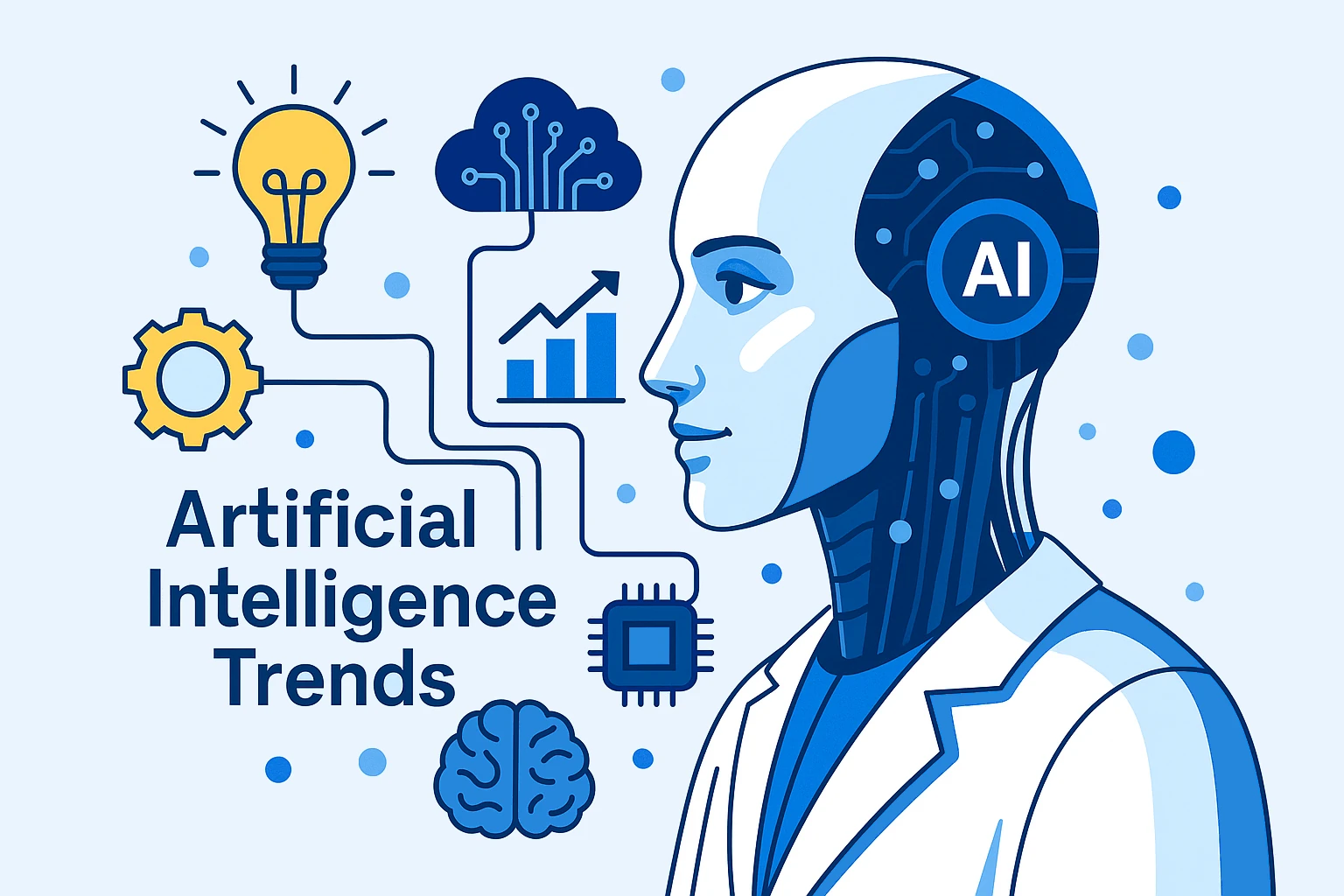
AI’s growth has been exponential over the last decade. Initially confined to narrow use cases like rule-based automation and speech recognition, AI now spans:
- Deep learning models that understand language and generate images
- Self-learning systems that adapt to new data without manual reprogramming
- Predictive analytics that forecast behaviors and outcomes across industries
The tipping point came with advances in transformer architectures, foundation models, and scalable cloud infrastructure, enabling wider accessibility and application of AI tools.
Why AI Trends Matter Across Industries
The significance of tracking AI trends lies in their transformative potential. Organizations leveraging the latest AI technologies are seeing:
- Increased operational efficiency through intelligent automation
- Improved decision-making with data-driven insights
- Enhanced customer experiences through personalization and chatbots
- Stronger security via AI-enabled threat detection systems
AI is not just a productivity tool, it’s becoming a strategic asset that determines competitiveness in the digital economy.
Key Drivers of AI Innovation in 2025
The push toward AI innovation is being driven by several converging forces:
- Data availability: The explosion of structured and unstructured data feeds machine learning systems at scale.
- Hardware advancements: GPUs, TPUs, and edge computing devices enable faster AI processing.
- Open-source ecosystems: Frameworks like TensorFlow, PyTorch, and Hugging Face accelerate development cycles.
- Investment growth: Venture capital and enterprise funding in AI startups remain robust, with billions poured into AI SaaS, robotics, and generative models.
- Public awareness and adoption: AI is becoming part of everyday life, from virtual assistants to smart recommendations and self-driving technology.
This foundational understanding of AI’s trajectory sets the stage for exploring the Top 10 AI Trends that are revolutionizing industries and driving innovation. Each trend in this list reflects not just technological advancement, but also a fundamental shift in how businesses and societies operate.
Generative AI and Creative Automation
Generative AI has emerged as one of the most disruptive technologies in 2025, revolutionizing how content is created, customized, and consumed. From art and copywriting to product design and synthetic media, Generative AI is redefining creativity across industries.
What is Generative AI?
Generative AI refers to machine learning models that can generate new content, such as text, images, music, video, and code, based on the data they’ve been trained on. These models, particularly large language models (LLMs) and diffusion-based image generators, use deep neural networks to:
- Predict and generate human-like text (e.g., GPT-4, Claude, Gemini)
- Create realistic visuals (e.g., Midjourney, DALL·E, Stable Diffusion)
- Compose music, develop games, and simulate voices
- Assist with 3D modeling, architecture, and animation
Industry Use Cases of Generative AI
Generative AI is already deeply embedded in multiple industries:
Marketing & Advertising:
- Auto-generating blog content, social media posts, ad copy, and SEO assets
- Designing banners, logos, and brand visuals
E-commerce:
- Personalized product descriptions
- Virtual try-on tools and AI-generated product images
Entertainment & Media:
- Scriptwriting, video editing, and special effects
- AI voiceovers and music scoring
Architecture & Design:
- Rapid prototyping and 3D design concepts
- AI-generated interior layouts and renderings
Gaming & Metaverse:
- AI-created characters, dialogue, and immersive environments
Business Impact and Productivity Gains
Generative AI dramatically reduces the time and cost involved in creative processes. Businesses report:
- 30%–70% reduction in content production time
- Higher personalization at scale without human bottlenecks
- Cost-effective marketing with consistent brand voice and visuals
Challenges and Ethical Considerations
Despite its promise, generative AI poses several risks:
- Misinformation and deepfakes: AI-generated content can be used to deceive.
- Copyright infringement: Questions persist over who owns the rights to AI-generated works.
- Bias and hallucinations: Models can reflect or amplify harmful biases, and generate incorrect information.
- Job displacement: Some creative roles may be replaced or reshaped by AI tools.
To counter these challenges, many companies are now implementing “human-in-the-loop” systems, AI content watermarking, and model auditing frameworks.
Leading Tools and Platforms in 2025
| Platform | Specialty | Notable Features |
|---|---|---|
| OpenAI GPT-4o | Text generation, coding | Fast, multimodal, API access |
| Midjourney v6 | Image creation | High realism, stylization controls |
| Runway Gen-3 | Video synthesis & editing | Text-to-video, green screen tools |
| Adobe Firefly | Creative suite integration | Photoshop + AI fusion |
| Stability AI | Open-source image generation | Community-driven development |
Generative AI is not just replacing human creativity, it’s enhancing it. As tools mature and ethical safeguards improve, this trend will continue to democratize content creation and unlock new possibilities across every visual and textual medium.
AI‑Powered Automation in Enterprises
AI-powered automation is no longer a futuristic vision, it’s a strategic imperative for enterprises across sectors. In 2025, businesses are integrating AI with process automation technologies to streamline operations, boost productivity, and reduce human error at unprecedented scales.
What is AI‑Powered Automation?
AI-powered automation blends traditional automation (e.g., rule-based systems and scripts) with artificial intelligence, enabling machines to:
- Learn from data and past decisions
- Adapt to changing inputs
- Make context-aware decisions
- Handle unstructured data (text, voice, images)
This evolution is leading to what is known as intelligent automation or hyperautomation.
Core Technologies Driving Enterprise Automation
- Robotic Process Automation (RPA): Automates repetitive tasks like data entry, invoice processing, and onboarding using bots. Tools like UiPath and Automation Anywhere now integrate AI to handle decision-making.
- Natural Language Processing (NLP): Powers chatbots, automated document processing, and voice assistants.
- Computer Vision: Used for quality inspection, document recognition, and security monitoring.
- AI-driven Decision Engines: Analyze complex data streams and make real-time decisions (e.g., fraud detection or supply chain optimization).
Key Use Cases Across Industries
Banking & Finance:
- KYC and AML automation
- Fraud detection and real-time risk scoring
Manufacturing:
- Predictive maintenance
- Automated quality control using AI vision
Retail & E-commerce:
- Dynamic pricing algorithms
- Smart inventory management
HR & Back-office Functions:
- Automated recruitment screening
- Payroll processing and compliance checks
Insurance:
- Claims processing automation
- Policy underwriting with AI assessments
Measurable Business Outcomes
Companies leveraging AI-powered automation report:
- 30%–80% reduction in processing time
- 25%–50% cost savings on operational overhead
- Higher employee satisfaction, as staff focus on strategic rather than repetitive tasks
- Improved accuracy and compliance, reducing regulatory penalties
According to Deloitte, 73% of organizations that implemented intelligent automation in 2024 reported a positive ROI within the first year.
Challenges to Adoption
Despite its benefits, scaling AI-powered automation involves:
- Integration complexity: Legacy systems often require expensive customization.
- Change management: Employee resistance and lack of digital skills can hinder adoption.
- Data silos: Inconsistent or inaccessible data impairs automation accuracy.
- Ethical concerns: Bias in algorithms and lack of transparency in AI decisions can create compliance risks.
Enterprises are addressing these challenges by investing in AI governance frameworks, retraining programs, and cross-functional automation centers of excellence (CoEs).
Future Outlook: The Rise of Autonomous Enterprises
The ultimate vision for AI-powered automation is the autonomous enterprise, an organization that can sense, reason, and act in real time with minimal human intervention. This involves:
- End-to-end automation of customer journeys
- Self-optimizing operations using AI feedback loops
- AI-led strategic decision-making
AI-powered automation isn’t just an efficiency tool; it’s becoming the backbone of modern enterprise agility and scalability. Companies that fail to adopt these innovations risk being outpaced by AI-native competitors.
AI in Healthcare and Drug Discovery
Among the most transformative applications of AI in 2025 is its role in healthcare, particularly in early diagnostics, drug development, and personalized medicine. AI has moved from pilot projects to mainstream adoption in hospitals, biotech firms, and pharmaceutical giants.
How AI Is Shaping Modern Healthcare
AI systems can now analyze complex medical data like imaging, genomics, and clinical records to:
- Detect diseases at earlier stages with greater accuracy
- Recommend personalized treatment plans
- Predict patient outcomes
- Accelerate the discovery and development of new drugs
This is made possible by advances in machine learning algorithms, increased computing power, and access to massive datasets from electronic health records and real-world clinical data.
AI in Diagnostics and Patient Care
- Medical Imaging: AI-powered tools detect tumors, fractures, and anomalies in X-rays, MRIs, and CT scans with precision rivaling or surpassing human radiologists.
- Virtual Health Assistants: AI chatbots and symptom checkers provide 24/7 support, reducing the burden on frontline staff.
- Predictive Analytics: AI models forecast patient deterioration in ICUs, hospital readmission risks, and even the onset of chronic diseases like diabetes or heart failure.
Example: Google’s DeepMind has developed an AI system capable of diagnosing over 50 eye diseases with the same accuracy as expert ophthalmologists (Nature, 2023).
Revolutionizing Drug Discovery with AI
Traditional drug development can take 10–15 years and cost billions. AI is dramatically shortening this cycle:
- Molecular Design: AI generates novel drug compounds by analyzing chemical and biological data.
- Clinical Trial Optimization: AI identifies ideal patient populations and predicts trial outcomes to reduce failure rates.
- Drug Repurposing: Algorithms screen existing medications for potential new uses, saving years of R&D.
- Synthetic Biology: AI aids in engineering new proteins and biologics for therapeutic purposes.
Case in point: Insilico Medicine’s AI-designed drug for idiopathic pulmonary fibrosis entered human trials in just 30 months, less than half the usual timeframe.
Real-World Applications in 2025
| Application Area | AI Solution Type | Notable Tools/Companies |
|---|---|---|
| Cancer diagnostics | Deep learning imaging | Paige AI, PathAI, Ibex Medical |
| Clinical decision support | Predictive modeling | IBM Watson Health, Tempus, Aidoc |
| Drug design | Generative chemistry | BenevolentAI, Insilico Medicine |
| Genomics | DNA sequence analysis | Deep Genomics, Helix, Illumina AI |
| Personalized treatment | AI-driven EHR analysis | Google Health, Microsoft Azure AI |
Ethical, Legal, and Regulatory Challenges
While AI’s impact on healthcare is profound, it also raises serious concerns:
- Patient privacy: Sensitive health data requires strict compliance with HIPAA, GDPR, and other data laws.
- Algorithmic bias: Training data disparities can lead to unequal outcomes across demographics.
- Explainability: Black-box AI decisions in medicine pose legal and ethical challenges.
- Regulatory hurdles: Approval processes for AI-based diagnostics and therapeutics are still evolving.
To address these, global health agencies are developing AI transparency guidelines, model validation protocols, and patient data consent frameworks.
AI in healthcare is not just improving clinical outcomes, it’s redefining the pace and personalization of care. As technology matures and trust grows, AI will become a fundamental partner in medical innovation and patient well-being.
AI in Financial Services
AI is rapidly transforming the financial services industry by optimizing operations, enhancing customer experiences, and mitigating risks. In 2025, banks, fintechs, and insurers are embedding AI into their core infrastructure to remain competitive in a digital-first economy.
Core AI Applications in Finance
AI’s role in finance extends across both front-end customer-facing processes and back-end operations:
- Fraud Detection & Risk Management: Machine learning algorithms identify unusual patterns in transactions, flagging fraudulent activity in real-time.
- Algorithmic Trading: AI analyzes market trends, economic indicators, and historical data to execute trades at optimal times.
- Credit Scoring & Loan Underwriting: AI models assess creditworthiness using non-traditional data (e.g., transaction history, mobile usage).
- Personalized Banking: Virtual assistants and recommendation engines tailor financial products to individual customers.
- RegTech & Compliance: AI helps financial institutions monitor transactions, detect money laundering, and ensure regulatory compliance.
Key Use Cases by Segment
| Segment | AI Use Case | Examples |
|---|---|---|
| Retail Banking | Chatbots, customer service automation | Erica (Bank of America), Eno (Capital One) |
| Investment Banking | AI-driven market analysis | JPMorgan’s LOXM, Goldman Sachs’ Kensho |
| Insurance | Claims automation, fraud detection | Lemonade, Tractable |
| Wealth Management | Robo-advisors, portfolio optimization | Betterment, Wealthfront |
| Payments & Fraud | Transaction monitoring | Mastercard AI, PayPal Risk Intelligence |
Business Impact and ROI
AI provides significant returns for financial institutions:
- Up to 90% improvement in fraud detection accuracy
- 30–50% reduction in operational costs
- Faster loan approvals and customer onboarding
- 24/7 customer support with AI chatbots handling over 80% of queries
According to Accenture, AI is expected to add $1.2 trillion in value to the global banking industry by 2035.
Explainable AI and Regulatory Compliance
One of the most complex challenges in finance is the “black box” nature of many AI models. This has led to a growing demand for:
- Explainable AI (XAI): Models that can provide human-understandable justifications for decisions, especially in credit approvals and compliance checks.
- AI model governance: Banks are forming AI ethics committees and implementing internal audit trails for automated decision-making.
- Global regulatory frameworks: The EU’s AI Act and U.S. Federal Reserve guidelines are pushing for increased transparency and fairness in AI usage.
Responsible AI in Finance
With the rise of automated decisions affecting individuals’ financial futures, financial firms are adopting responsible AI practices:
- Bias audits and fairness testing
- Consent-driven data usage policies
- Human-in-the-loop systems for critical decisions
- Cross-border data governance and cybersecurity protocols
AI in financial services is evolving from optional enhancement to core operational intelligence. As technologies like generative AI and quantum computing mature, the future of finance will be more predictive, personalized, and secure.
Edge AI and Real-Time Analytics
In 2025, the shift from centralized cloud-based AI to Edge AI is accelerating. Edge AI where artificial intelligence processing happens directly on devices or local nodes, enables real-time decision-making, lower latency, and better data privacy. This trend is proving essential for applications that require immediate responses and operate in environments with limited internet connectivity.
What Is Edge AI?
Edge AI combines edge computing (processing data near its source) with AI algorithms to deliver smart capabilities on:
- IoT devices
- Smartphones
- Drones
- Cameras
- Industrial robots
This allows devices to analyze and act on data locally without needing to constantly communicate with a cloud server.
Key Differences: Cloud AI vs. Edge AI
| Feature | Cloud AI | Edge AI |
|---|---|---|
| Data Processing | Centralized (data sent to cloud) | Local (on-device or on-premise) |
| Latency | Higher due to transmission delays | Ultra-low, ideal for real-time needs |
| Privacy & Security | Depends on cloud encryption | Improved, as data stays on device |
| Connectivity Need | Requires stable internet connection | Can operate offline or intermittently |
Real-World Applications of Edge AI
Manufacturing:
- Real-time quality control via computer vision
- Predictive maintenance on factory equipment
Retail:
- Smart shelves and inventory tracking
- In-store customer behavior analytics
Autonomous Vehicles:
- Object detection, route planning, and braking systems processed in milliseconds
Healthcare:
- Portable diagnostic devices that analyze patient vitals in the field
Smart Cities:
- AI-enabled traffic management, surveillance, and energy efficiency systems
Benefits of Edge AI
- Reduced latency: Critical for safety-focused applications like autonomous driving and surgery robots.
- Lower bandwidth usage: Minimal data sent to cloud servers reduces operational costs.
- Enhanced privacy: Sensitive data (e.g., health or facial recognition) is processed on-device.
- Operational resilience: Systems can continue functioning during connectivity losses.
Challenges and Considerations
- Hardware limitations: Edge devices have constrained computing resources, requiring model optimization and compression.
- Security: While local processing protects data, physical device tampering is a greater risk.
- Deployment complexity: Scaling AI updates across thousands of edge devices is a logistical challenge.
- Cost: Initial investment in specialized hardware and software can be high.
Leading Technologies and Providers
| Technology/Tool | Functionality | Providers |
|---|---|---|
| NVIDIA Jetson | Edge AI development boards | NVIDIA |
| Intel OpenVINO | Model optimization for edge devices | Intel |
| AWS IoT Greengrass | Local AI processing for IoT | Amazon Web Services |
| Microsoft Azure Percept | Vision and voice AI at the edge | Microsoft |
| Qualcomm AI Engine | On-device AI for mobile & robotics | Qualcomm |
Edge AI is rapidly becoming the backbone of decentralized intelligence, fueling smarter, faster, and more private interactions between machines and their environments. As hardware matures and deployment becomes easier, expect to see edge AI everywhere, from city intersections to factory floors.
AI‑Enhanced Cybersecurity
As cyber threats grow in volume and sophistication, traditional cybersecurity measures are no longer enough. In 2025, AI-enhanced cybersecurity is playing a critical role in defending against dynamic and complex attacks by providing proactive threat detection, real-time response, and automated defense mechanisms.
The Rise of AI in Cyber Defense
AI systems are now capable of:
- Monitoring large volumes of data across networks
- Detecting anomalies or suspicious patterns in real time
- Predicting and neutralizing threats before they cause damage
- Automating incident response workflows
These capabilities enable security teams to shift from reactive to predictive and adaptive security models.
Key Use Cases of AI in Cybersecurity
Threat Detection and Intelligence:
- AI identifies previously unknown malware and zero-day exploits using behavioral analysis.
- Natural language processing (NLP) extracts threat intelligence from unstructured data sources like forums and dark web chatter.
Endpoint Security:
- AI continuously monitors devices to detect unusual behavior, such as unauthorized access or data exfiltration.
Network Security:
- AI-powered intrusion detection systems (IDS) and intrusion prevention systems (IPS) identify complex attacks across hybrid environments.
Identity and Access Management (IAM):
- AI helps detect unauthorized access attempts by analyzing user behavior and login patterns.
- Biometric authentication systems now use AI for face, fingerprint, and voice recognition.
Phishing and Social Engineering Defense:
- AI models filter out sophisticated spear-phishing emails and malicious links with high accuracy.
AI-Powered Cybersecurity Tools in 2025
| Tool/Platform | Core Functionality | Providers |
|---|---|---|
| Darktrace | Autonomous threat detection & response | Darktrace |
| CrowdStrike Falcon | Endpoint protection with AI | CrowdStrike |
| Microsoft Defender for AI | Enterprise security analytics | Microsoft |
| Vectra AI | Network threat detection & response | Vectra |
| IBM QRadar | AI-enhanced SIEM and threat intelligence | IBM |
Business Impact
Organizations using AI in cybersecurity report:
- 60–90% faster threat detection and response times
- Reduction in false positives, easing the workload on human analysts
- Improved compliance with data protection regulations via automated audit trails
- Better protection against insider threats and advanced persistent threats (APTs)
Emerging Threats and AI Arms Race
While AI strengthens cybersecurity, it also empowers cybercriminals:
- AI-generated phishing attacks are more convincing and harder to detect.
- Malware that adapts to evade detection using AI algorithms is becoming more common.
- Deepfake attacks targeting voice and video authentication systems are on the rise.
This creates an “AI arms race” between defenders and attackers, pushing enterprises to continuously evolve their AI defense strategies.
Ethical and Regulatory Considerations
- Transparency: AI decisions in blocking users or flagging content must be explainable to avoid wrongful actions.
- Bias and fairness: Security systems must avoid discriminatory profiling based on race, geography, or behavior patterns.
- Compliance: Use of AI in security must align with data protection regulations like GDPR, CCPA, and upcoming AI-specific laws.
AI-enhanced cybersecurity is becoming indispensable for protecting digital assets in an increasingly hostile threat landscape. The organizations that integrate AI into their security stack are not just defending better, they’re building trust, ensuring compliance, and future-proofing their digital infrastructure.
Multimodal AI Models
Multimodal AI represents a major leap in artificial intelligence, enabling systems to understand and generate content across multiple data types such as text, image, audio, and video simultaneously. In 2025, these models are reshaping how machines interact with the world, powering new applications in media, education, healthcare, and immersive experiences.
What Are Multimodal AI Models?
Multimodal AI models are trained on integrated datasets that span various modalities. Instead of analyzing just one type of input (e.g., text or image), they combine them to generate richer outputs and enable more contextual understanding.
Examples include:
- Answering a question about an image (visual question answering)
- Creating videos from a text prompt
- Generating images with voice descriptions
- Translating sign language using video and speech data
Prominent multimodal models in 2025 include OpenAI’s GPT-4o, Google’s Gemini 1.5, and Meta’s ImageBind, all of which can handle text, images, audio, and even code in a single query.
Use Cases and Applications
Customer Support:
- AI assistants can now analyze user-uploaded images, text descriptions, and voice input to resolve issues more accurately.
Education & E-Learning:
- Personalized learning experiences that combine video lectures, real-time voice interaction, and AI-generated study guides.
Healthcare:
- Combining medical images (e.g., X-rays) with patient history and audio transcriptions for enhanced diagnostics.
Retail & E-commerce:
- Visual search tools where users upload photos and receive product matches with AI-generated descriptions and reviews.
Content Creation & Marketing:
- Generating rich multimedia content (e.g., infographics, videos, captions) from a single command or prompt.
Technical Foundations of Multimodal AI
- Transformer Architectures: Models like ViT (Vision Transformer) and Perceiver allow seamless integration of image, audio, and text data.
- Contrastive Learning: Techniques like CLIP align visual and textual data for cross-modal tasks.
- Token Unification: Unified token systems allow models to interpret all modalities in a consistent format.
Advantages of Multimodal AI
- More natural interactions: Mimics human ability to process and communicate using multiple senses.
- Greater accessibility: Supports diverse user needs, including visual and speech impairments.
- Richer contextual understanding: Enhances decision-making by analyzing layered input data.
Challenges and Risks
- Computational cost: Training and running multimodal models require significant resources.
- Data alignment: Ensuring coherence between modalities during training can be difficult.
- Bias and hallucinations: Models may reinforce stereotypes or generate incorrect cross-modal associations.
- Security risks: Multimodal deepfakes and misinformation are harder to detect.
Market and Investment Trends
- Over $5 billion was invested in multimodal AI startups between 2023 and 2025.
- Major tech players are racing to build universal models that can power everything from voice assistants to augmented reality systems.
Multimodal AI is ushering in a new era of intelligent systems that think and communicate like humans do across formats and senses. It’s not just a technological milestone; it’s a paradigm shift in how we build and interact with artificial intelligence.
AI Ethics and Regulatory Frameworks
As AI systems become more powerful and embedded in daily life, the need for ethical guidelines and regulatory frameworks has become urgent. In 2025, governments, corporations, and global organizations are racing to establish policies that ensure AI technologies are safe, fair, transparent, and accountable.
Why AI Ethics and Regulation Matter
AI systems influence decisions on employment, healthcare, policing, lending, and access to services. Without oversight, they can:
- Perpetuate or exacerbate bias and discrimination
- Lack accountability for harmful outcomes
- Violate privacy and consent norms
- Enable surveillance and misuse (e.g., deepfakes, automated profiling)
Public trust in AI hinges on how responsibly it is developed and deployed making ethics and regulation critical to sustainable innovation.
Global AI Regulatory Developments
Several regions have introduced or proposed sweeping AI legislation:
European Union (EU AI Act):
- World’s first comprehensive legal framework for AI
- Categorizes AI systems by risk: unacceptable, high-risk, limited, and minimal
- Requires transparency, documentation, and human oversight for high-risk AI (e.g., facial recognition, hiring tools)
United States:
- No unified federal law yet, but active regulation by agencies like the FTC and NIST
- Biden’s Executive Order on Safe, Secure, and Trustworthy AI (2023) promotes transparency, equity, and national security safeguards
China:
- Focuses on content moderation, algorithm transparency, and data localization
- Strong emphasis on national security and state oversight
OECD, UNESCO, and G7:
- Promoting global collaboration on ethical AI standards and cross-border governance
Ethical Principles for Responsible AI
Most frameworks, regardless of geography, align around key principles:
| Ethical Principle | Description |
|---|---|
| Fairness and Non-discrimination | Avoid bias based on race, gender, age, etc. |
| Transparency | AI decisions should be explainable and traceable |
| Accountability | Clear human responsibility for AI outcomes |
| Privacy and Consent | Data collection and use must respect individual rights |
| Safety and Security | Systems should be robust against misuse and manipulation |
| Human-Centric Design | AI should augment, not replace human judgment and dignity |
Tools and Practices for Ethical AI
- Bias Auditing Tools: Evaluate training data and model outputs for bias (e.g., AI Fairness 360, Fairlearn)
- Model Explainability Platforms: Tools like SHAP and LIME help explain how models make decisions
- Data Governance Frameworks: Define protocols for responsible data collection, labeling, and use
- Ethics Committees and AI Boards: Internal oversight bodies for enterprise AI initiatives
Corporate Responsibility and AI Governance
Many companies are taking proactive steps:
- Google: Implemented an AI Principles policy guiding product design and deployment
- Microsoft: Offers a Responsible AI Standard and open-source tools for fairness and reliability
- IBM: Publishes transparency documents for all major AI offerings
These initiatives not only reduce legal risk but also differentiate ethical companies in the market.
AI ethics and regulation are not roadblocks, they’re the foundation for trustworthy, sustainable AI innovation. As the world aligns on guiding principles and practical safeguards, businesses must ensure their AI strategies go beyond compliance to embrace true responsibility.
AI in Sustainable Technologies
AI is increasingly being deployed to tackle some of the planet’s most urgent sustainability challenges. From optimizing energy usage to predicting environmental risks, AI in sustainable technologies is enabling industries and governments to make data-driven decisions that support climate action and resource conservation.
How AI Supports Sustainability Goals
Artificial intelligence enhances sustainability by:
- Reducing energy consumption through optimization
- Monitoring environmental changes in real time
- Improving resource efficiency across supply chains
- Accelerating climate modeling and impact forecasting
- Enabling smarter infrastructure and cities
These capabilities align with ESG (Environmental, Social, and Governance) standards and the UN Sustainable Development Goals (SDGs).
Key Applications of AI in Sustainability
Energy Sector:
- AI predicts electricity demand to balance grids and reduce waste
- Optimizes the performance of solar panels and wind turbines
- Enables dynamic pricing and energy trading systems
Agriculture & Food Systems:
- AI-powered precision farming conserves water, fertilizer, and land
- Image recognition detects plant diseases early to reduce pesticide use
- Predictive analytics supports yield forecasting and crop planning
Smart Cities:
- AI analyzes traffic and lighting data to reduce energy waste
- Enhances public transport efficiency and air quality monitoring
Climate Science & Conservation:
- Satellite-based AI tracks deforestation, glacier melt, and carbon emissions
- Models climate scenarios to guide policymaking and disaster readiness
Example Technologies & Solutions
| Sector | AI Application | Notable Platforms/Companies |
|---|---|---|
| Energy Management | Grid optimization & forecasting | Google DeepMind, Siemens Grid Edge |
| Agriculture | Soil monitoring, pest detection | PEAT Plantix, IBM Watson Decision Platform |
| Environmental Data | Remote sensing & climate modeling | Microsoft Planetary Computer |
| Transportation | Route optimization, traffic prediction | Waze AI, NVIDIA Metropolis |
Business & Environmental Impact
Enterprises integrating AI for sustainability report:
- 10–40% reductions in energy costs
- Higher regulatory compliance with emissions and waste targets
- Improved ESG ratings, appealing to investors and stakeholders
- Early risk detection (e.g., floods, supply disruptions)
For example, Google’s use of DeepMind AI to cool its data centers resulted in a 40% reduction in energy used for cooling, saving millions annually (Google Sustainability).
Challenges in AI-Driven Sustainability
- Data availability and quality: Incomplete or biased environmental data limits AI effectiveness.
- Carbon footprint of AI models: Training large models can consume significant energy unless offset.
- Investment barriers: Upfront costs deter smaller organizations from adopting AI solutions.
- Interdisciplinary complexity: Sustainability solutions often require coordination across technical, environmental, and policy teams.
Moving Toward Greener AI
The sustainability of AI itself is becoming a focus. Practices include:
- Training models on green cloud platforms (powered by renewable energy)
- Using model compression to reduce computational load
- Applying carbon accounting for AI projects
- Choosing smaller, purpose-specific models when large models are not needed
AI in sustainable technologies represents a synergy between innovation and environmental responsibility. As climate risks intensify, the role of AI will be central in helping humanity adapt, mitigate, and build a greener future.
AI for Personalized Customer Experiences
In the era of hyper-competition and digital saturation, delivering personalized experiences is no longer optional, it’s expected. In 2025, AI is at the heart of personalization strategies, enabling brands to understand individual customer preferences, predict behavior, and deliver tailored content, recommendations, and interactions at scale.
The Role of AI in Personalization
AI systems ingest and analyze massive volumes of customer data, demographic, behavioral, transactional, and contextual to:
- Segment audiences in real time
- Recommend products or services
- Customize content across channels
- Predict future behavior and preferences
- Automate one-to-one marketing communication
This leads to experiences that feel less like mass marketing and more like genuine one-on-one relationships.
Key Use Cases Across Industries
E-commerce:
- Product recommendation engines (e.g., Amazon, Shopify)
- Dynamic pricing based on browsing and purchase behavior
Media & Entertainment:
- Personalized content feeds (e.g., Netflix, Spotify, TikTok)
- Tailored advertising and in-app recommendations
Banking & Finance:
- AI-driven financial coaching and investment tips
- Customized alerts and offers based on transaction patterns
Healthcare:
- Personalized wellness plans and digital health recommendations
- AI-based symptom checkers tuned to individual health histories
Travel & Hospitality:
- Real-time itinerary suggestions and hotel recommendations
- Predictive upgrades and loyalty rewards
Core Technologies Enabling Personalization
- Machine Learning (ML): Predicts customer needs and preferences using historical and real-time data.
- Natural Language Processing (NLP): Powers chatbots, voice assistants, and sentiment analysis.
- Computer Vision: Enables visual product recommendations and in-store personalization.
- Customer Data Platforms (CDPs): Integrate and organize customer data for AI use.
- Generative AI: Creates tailored emails, landing pages, and ad creatives automatically.
Business Impact of AI-Driven Personalization
Companies that excel at personalization benefit from:
- 20–40% increase in conversion rates
- Higher average order values and customer lifetime value (CLV)
- Reduced churn through targeted re-engagement
- Stronger brand loyalty via personalized communication
A McKinsey study in 2024 found that businesses using AI to personalize the customer journey grew revenue 40% faster than competitors who didn’t.
Ethical Considerations and Customer Trust
As personalization gets more advanced, it raises ethical and privacy concerns:
- Data privacy: Customers want transparency about how their data is used.
- Consent: AI systems must respect opt-in/opt-out preferences for personalized content.
- Bias in recommendations: Algorithms should not reinforce stereotypes or exclude certain user groups.
- Over-personalization: Can feel invasive if not balanced with user control and consent.
Companies that prioritize privacy-preserving personalization using techniques like federated learning and differential privacy will win long-term trust.
AI-powered personalization transforms customer interactions from generic to deeply relevant and responsive. Brands that leverage AI not just to sell, but to understand and serve, are setting the standard for customer experience in the digital economy.
Leading AI Companies
Microsoft
- Basic Info: Microsoft is one of the largest players in AI, with its Azure AI platform, Copilot integrations, and a multibillion-dollar partnership with OpenAI.
- Recent News: Launched Copilot across Office 365 and Windows, embedding AI deeply into enterprise workflows. In 2024, it expanded its Azure OpenAI Service globally.
- Competitive Analysis: Competes directly with Google Cloud AI, AWS AI, and IBM Watson. Its edge lies in enterprise adoption and OpenAI integration.
- Financials: Microsoft’s FY2024 revenue was $245.12B (+17% YoY), with Azure and AI services contributing the fastest growth segment.
Alphabet (Google)
- Basic Info: Alphabet dominates AI R&D through Google DeepMind, Google Cloud AI, and its generative AI platform Gemini (formerly Bard).
- Recent News: In late 2024, Alphabet rebranded Bard into Gemini, positioning it as a direct competitor to ChatGPT and Microsoft Copilot.
- Competitive Analysis: Strong in research leadership (DeepMind) and AI integration across Search, YouTube, and Ads. Competes heavily with Microsoft/OpenAI.
- Financials: Alphabet’s FY2024 revenue was $307.4B, with Google Cloud AI revenues exceeding $36B.
Amazon (AWS AI & Alexa)
- Basic Info: Amazon Web Services (AWS) is the largest cloud provider, offering AI services like SageMaker and custom AI chips (Trainium, Inferentia).
- Recent News: In 2024, Amazon committed $4B in Anthropic, an OpenAI rival, to boost its generative AI capabilities.
- Competitive Analysis: Amazon’s strength lies in developer AI tools and cloud infrastructure scale. However, it lags in consumer-facing AI adoption compared to Microsoft/Google.
- Financials: Amazon’s FY2024 revenue reached $590B, with AWS contributing $105B in revenue, a significant share from AI-driven workloads.
NVIDIA
- Basic Info: NVIDIA powers the global AI revolution with its GPU hardware and CUDA software ecosystem, making it the backbone of AI training and inference.
- Recent News: In 2024, NVIDIA crossed $3 trillion in market cap, driven by demand for AI GPUs like H100 and new Blackwell architecture.
- Competitive Analysis: Faces competition from AMD and custom AI chips by Google, Amazon, and Microsoft—but remains dominant in AI compute.
- Financials: NVIDIA’s FY2024 revenue was $60.9B, with AI GPU sales driving 75% of revenue. Profit margins soared past 70%.
IBM (Watson & Hybrid AI)
- Basic Info: IBM focuses on enterprise AI with Watsonx, delivering AI-powered solutions for healthcare, finance, and hybrid cloud.
- Recent News: In 2024, IBM launched Watsonx Orchestrate, an AI productivity tool for enterprise workflows.
- Competitive Analysis: Unlike Google/Microsoft, IBM targets enterprise AI governance and compliance, making it a leader in trustworthy AI.
- Financials: IBM’s FY2024 revenue stood at $62.0B, with AI/cloud services contributing 37% of total revenues.
OpenAI (Private Company)
- Basic Info: Creator of ChatGPT, DALL·E, and Codex, OpenAI is at the center of the generative AI wave, backed by Microsoft.
- Recent News: In 2024, OpenAI launched GPT-5 and enterprise-grade AI assistants, expanding its business adoption.
- Competitive Analysis: Faces direct competition from Google’s Gemini, Anthropic’s Claude, and Meta’s LLaMA models. Its Microsoft partnership ensures scale.
- Financials: OpenAI is privately held; projected revenue for FY2024 exceeded $3.4B, up from $1.6B in 2023.
Future Outlook of AI and Industry Transformation
Artificial intelligence is transitioning from a helpful tool to essential infrastructure. By 2030, AI will underpin autonomous operations, real-time systems, and personalized services across every sector from healthcare and finance to energy and education.
Cross-Industry Disruption Ahead
AI is enabling:
- Autonomous logistics and retail operations
- Smart energy systems and responsive cities
- Predictive healthcare and personalized medicine
- Dynamic, AI-managed financial systems
Industries will increasingly operate as interconnected ecosystems powered by data and intelligent automation.
Emerging Trends Shaping the Future
AI + Quantum Computing: Could accelerate simulations in areas like drug discovery and cryptography.
- Multimodal AI: Expanding toward general-purpose intelligence with cross-domain learning.
- Smarter Robotics: Adaptive robots transforming manufacturing, agriculture, and eldercare.
- AI-as-a-Service: Making AI more accessible through cloud-based platforms.
- AI Governance Standards: Formalizing ethical certifications and model accountability.
What Businesses Must Do
To stay ahead, leaders need to:
- Upskill teams in AI literacy and collaboration
- Build scalable, ethical AI infrastructure
- Establish governance to manage risk and compliance
- Embrace agile, innovation-driven cultures
Augmenting, Not Replacing Humans
AI will augment not replace human roles. Soft skills, ethical oversight, and creative thinking will become even more valuable as AI takes on routine tasks.
Shared Responsibility
The future of AI demands responsible innovation. This includes:
- Equitable access to AI benefits
- Transparency in decision-making
- Collaboration on global risks and standards
AI is not just shaping industries, it’s redefining how we live and work. The organizations that act now, with clarity and responsibility, will lead in a world shaped by intelligent systems.