
Introduction to Stripe: Powering Modern Digital Commerce
As businesses increasingly move online, the demand for reliable and scalable online payment gateway solutions has grown significantly. From startups and ecommerce stores to global enterprises, organizations need seamless ways to accept payments, manage subscriptions, and expand internationally. This shift has created opportunities for companies that provide robust digital financial infrastructure, and Stripe has emerged as one of the leaders in this space.
Founded in 2010 by Patrick Collison and John Collison, Stripe began with a simple mission:
Increase the GDP of the internet.
Today, Stripe offers a wide range of payment services that go far beyond payment processing. Its platform enables businesses to accept payments, manage recurring billing, prevent fraud, automate revenue operations, and access embedded financial products. What started as a developer-friendly solution has evolved into one of the world’s most widely used financial infrastructure platforms.
Why Stripe Matters in the Digital Economy
Stripe’s success has been driven by its focus on simplicity, scalability, and innovation. By making online payment processing easier for developers and businesses, the company has helped accelerate the growth of ecommerce, SaaS platforms, marketplaces, and digital-first businesses.
By 2025, businesses using Stripe processed $1.9 trillion in total payment volume, equivalent to approximately 1.6% of global GDP. More than 5 million businesses used Stripe directly or through platforms built on its infrastructure.
Over the years, Stripe has transformed from a startup solving payment integration challenges into a global leader in digital finance. Its journey offers valuable insights into innovation, platform strategy, and the future of internet commerce.
The Origins of Stripe: Turning a Frustration Into an Opportunity
Stripe was founded in 2010 by Patrick Collison and John Collison, two Irish brothers who believed that accepting payments online should be much simpler than it was. At the time, businesses often had to deal with lengthy approval processes, complex integrations, and multiple financial intermediaries to start accepting online payments.

Recognizing this pain point, the founders set out to build a developer-friendly online payment gateway that could be integrated with just a few lines of code.
Identifying the Gap in the Market
Traditional payment systems were not designed with software developers in mind. Setting up payment infrastructure was often slow and cumbersome, creating unnecessary barriers for startups and internet businesses.
Stripe aimed to solve these challenges by focusing on:
- Simplicity and ease of integration.
- Faster onboarding for businesses.
- Scalable infrastructure for internet commerce.
- Support for global online transactions.
This developer-first philosophy became one of Stripe’s biggest competitive advantages.
Early Growth and Public Launch
The company participated in the Y Combinator accelerator program and initially operated in private beta before launching publicly in 2011. Early support from prominent investors and technology entrepreneurs helped Stripe gain traction among startups and developers.
What started as a simple solution for accepting payments would eventually evolve into a comprehensive platform offering a broad range of payment services for businesses around the world.
Understanding Stripe’s Business Model: Building More Than a Payment Processor
At its core, Stripe operates as a financial infrastructure company that provides businesses with tools to accept payments and manage various aspects of their revenue operations. Over time, the company has expanded far beyond being just an online payment gateway, creating an ecosystem of products that serve startups, enterprises, marketplaces, and software platforms.
This diversified approach has enabled Stripe to generate revenue from multiple sources while deepening its relationships with customers.
How Stripe Works
Stripe provides APIs and software tools that allow businesses to accept payments online, automate recurring billing, issue invoices, detect fraud, and facilitate payouts. Instead of building these capabilities from scratch, companies can integrate Stripe’s infrastructure into their applications and websites.
Today, Stripe supports hundreds of payment methods and serves millions of businesses globally, making it one of the most widely adopted online payment platforms.
Multiple Revenue Streams
Unlike traditional payment processors that rely primarily on transaction fees, Stripe has built several sources of revenue.
- Transaction Fees: The majority of Stripe’s revenue comes from fees charged on payment transactions processed through Stripe Payments.
- Subscription and Revenue Management Products: Products such as Billing, Invoicing, and Revenue Recognition generate recurring revenue while helping businesses automate financial operations.
- Platform and Marketplace Solutions: Stripe Connect enables marketplaces and SaaS platforms to manage payments and payouts, creating additional revenue opportunities.
- Financial and Banking Products: Services like Treasury, Capital, and Issuing have expanded Stripe’s presence in embedded finance and broader payment services.
A Platform Ecosystem Strategy
One of Stripe’s biggest strengths is its ecosystem approach. Businesses often begin by using Stripe Payments and later adopt complementary products, increasing customer retention and expanding Stripe’s revenue opportunities.
Some of Stripe’s major product categories include:
- Payment processing.
- Subscription billing.
- Fraud prevention.
- Invoicing and revenue automation.
- Embedded finance solutions.
- Identity and compliance services.
This strategy has helped Stripe evolve from a payment processor into a comprehensive financial infrastructure platform.
Why Businesses Choose Stripe Payments
Several factors have contributed to Stripe’s widespread adoption:
- Developer-friendly APIs.
- Fast implementation and onboarding.
- Support for global payments and multiple currencies.
- Strong security and fraud prevention capabilities.
- Broad suite of integrated financial products.
By continuously expanding its ecosystem, Stripe has positioned itself as much more than an online payment gateway, enabling businesses to manage an increasing share of their financial operations from a single platform.
Stripe’s Product Portfolio: Expanding Beyond Payments
What began as a simple payment processing solution has evolved into a broad suite of products that address various aspects of online commerce. Today, Stripe offers much more than an online payment gateway, providing businesses with integrated payment services, revenue management tools, and financial infrastructure.
This expanding portfolio has been a key driver of Stripe’s growth and customer retention.
Core Products Powering the Stripe Ecosystem
| Product | Primary Purpose |
|---|---|
| Stripe Payments | Online payment processing |
| Checkout | Prebuilt payment pages |
| Billing | Subscription management |
| Connect | Marketplace and platform payments |
| Radar | Fraud prevention |
| Invoicing | Automated invoicing |
| Terminal | In-person payments |
| Treasury | Embedded financial accounts |
| Identity | Identity verification |
| Atlas | Startup incorporation services |
Stripe Payments
Stripe Payments remains the company’s flagship offering. It enables businesses to accept card payments, digital wallets, bank transfers, and numerous local payment methods through a unified platform.
The solution supports global commerce and forms the foundation of Stripe’s broader ecosystem.
Checkout and Billing
Stripe Checkout provides ready-to-use payment pages that simplify the buying experience, while Stripe Billing helps businesses manage subscriptions, recurring payments, and revenue operations.
These products are particularly popular among SaaS companies and subscription-based businesses.
Connect and Marketplace Infrastructure
Stripe Connect enables platforms and marketplaces to onboard users, route payments, and distribute funds efficiently. Companies operating multi-sided platforms use Connect to simplify complex payment flows.
Risk Management and Revenue Automation
Several products help businesses streamline financial operations:
- Stripe Radar for fraud detection.
- Invoicing for automated billing.
- Revenue Recognition for accounting compliance.
- Tax solutions for managing indirect taxes.
Together, these products reduce operational complexity and improve efficiency.
Moving Into Financial Services
Over the years, Stripe has expanded into embedded finance through products such as:
- Stripe Treasury.
- Stripe Capital.
- Stripe Issuing.
- Stripe Identity.
These offerings allow businesses to provide financial capabilities directly within their own applications, strengthening Stripe’s position in the broader payment services ecosystem.
By continuously adding new capabilities, Stripe has transformed from a payment processor into a comprehensive financial infrastructure platform that supports businesses at every stage of growth.
How Stripe Became a Leading Online Payment Gateway
Stripe entered a crowded market dominated by established players, yet it managed to become one of the most influential companies in digital commerce. Its success was not driven by aggressive marketing or first-mover advantage, but by a relentless focus on solving problems for developers and businesses. Stripe’s API-first approach shares similarities with Visa’s Contactless Payments and API Services: Powering the Future, which highlights how APIs are transforming modern payment infrastructure.
Over the years, this approach helped Stripe evolve into a leading online payment gateway used by millions of businesses worldwide.
A Developer-First Philosophy
From the beginning, Stripe focused on developers rather than financial institutions. Its APIs were designed to be simple, well-documented, and easy to integrate, allowing businesses to start accepting payments with minimal effort.
This developer-centric approach became one of Stripe’s defining strengths and helped it gain early traction among startups and software companies.
Making Payments Simpler
Traditional payment systems often involved lengthy setup processes and complex infrastructure. Stripe simplified the experience by offering:
- Quick onboarding.
- Easy API integration.
- Unified payment infrastructure.
- Extensive documentation and support.
By reducing friction, Stripe enabled businesses to launch products faster and scale more efficiently.
Expanding Beyond Basic Payment Processing
Rather than remaining a standalone payment processor, Stripe gradually built an ecosystem of complementary products. Businesses that initially adopted Stripe Payments often expanded into products such as Billing, Connect, Radar, and Treasury.
This platform strategy increased customer loyalty and created multiple revenue streams.
Building for Global Commerce
As internet businesses expanded internationally, Stripe invested heavily in supporting cross-border transactions and local payment methods.
Its platform now enables businesses to:
- Accept payments in multiple currencies.
- Support local payment preferences.
- Manage international transactions.
- Expand into new markets with fewer operational barriers.
These capabilities have made Stripe particularly attractive to fast-growing global businesses.
Innovation as a Competitive Advantage
Stripe has consistently reinvested in technology and product development. The company has expanded into areas such as embedded finance, artificial intelligence, identity verification, and stablecoin infrastructure.
Its willingness to continuously innovate has allowed Stripe to stay ahead in an increasingly competitive market.
Key Factors Behind Stripe’s Success
| Success Factor | Impact |
|---|---|
| Developer-friendly APIs | Faster adoption among startups and software companies |
| Simple onboarding | Reduced friction for businesses |
| Broad product ecosystem | Higher customer retention |
| Global payment capabilities | Support for international growth |
| Continuous innovation | Expansion beyond traditional payments |
| Strong security infrastructure | Increased trust and reliability |
By combining simplicity, scalability, and constant innovation, Stripe transformed itself from a startup with a single product into one of the world’s leading providers of payment services and financial infrastructure. This foundation would also shape the sophisticated technology architecture that powers Stripe behind the scenes.
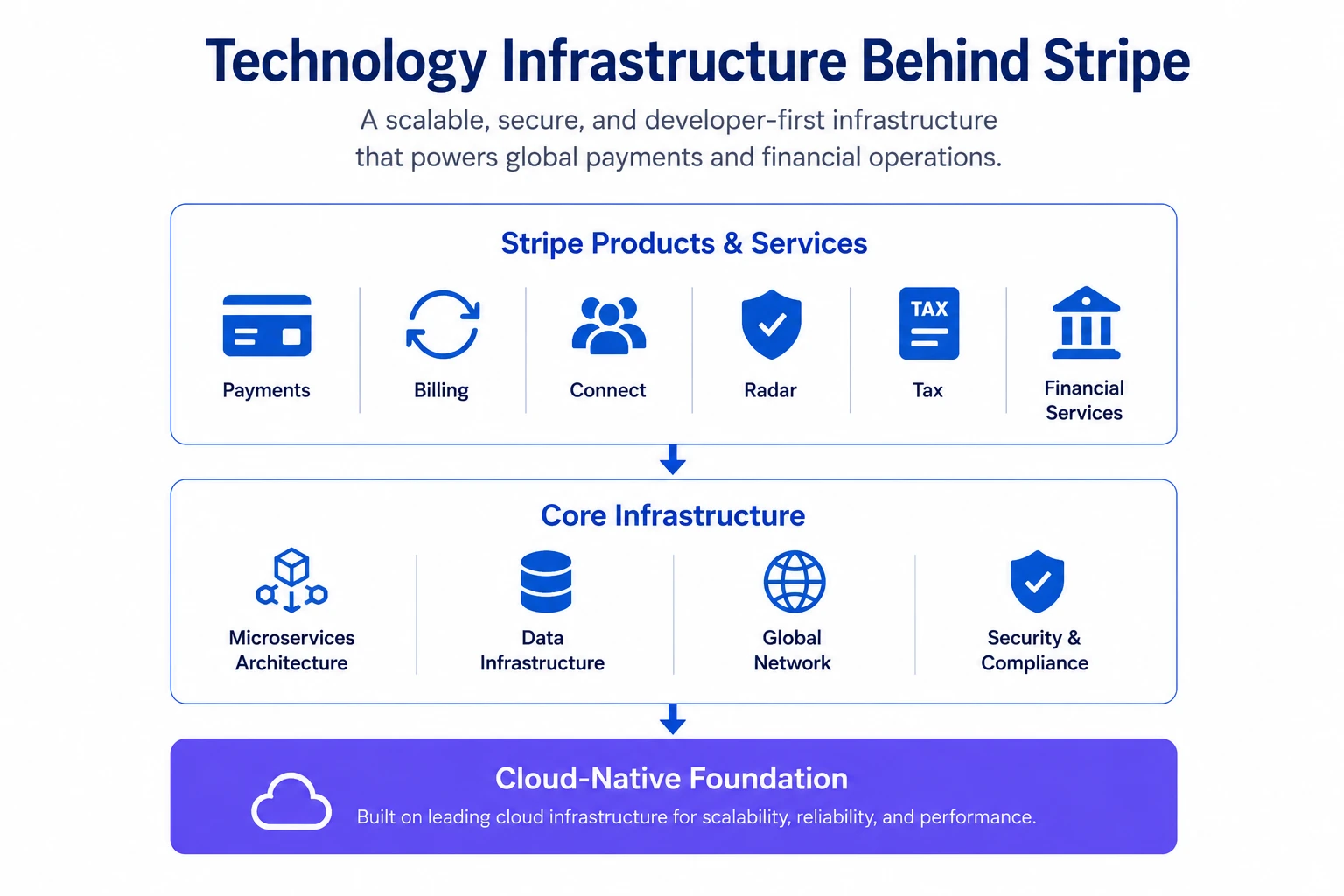
Technology Infrastructure Behind Stripe: The Engine Powering Internet Commerce
Behind Stripe’s success lies a sophisticated technology stack designed for scale, reliability, and flexibility. Rather than treating payments as isolated transactions, Stripe built a programmable infrastructure that enables businesses to integrate financial capabilities directly into their applications.
This technology-first approach has been instrumental in establishing Stripe as a leading online payment gateway and financial infrastructure provider.
API-First Architecture
One of Stripe’s biggest differentiators is its API-driven design. Developers can integrate payment acceptance, subscriptions, invoicing, and other financial functions using a consistent set of APIs.
This approach offers several advantages:
- Faster implementation.
- Greater flexibility.
- Easier customization.
- Better developer experience.
As a result, startups and enterprises alike can build payment experiences tailored to their specific needs.
Cloud-Native and Scalable Infrastructure
Stripe’s systems are designed to handle massive transaction volumes while maintaining high reliability. As the company’s customer base expanded globally, its infrastructure evolved to support increasing complexity and scale.
By 2025, businesses using Stripe processed $1.9 trillion in total payment volume, up from $1.4 trillion in 2024 and $1 trillion in 2023, demonstrating the platform’s ability to scale alongside its customers.
Machine Learning and Fraud Prevention
Security and trust are critical for any online payment processing platform. Stripe uses machine learning to identify fraudulent activity and improve authorization rates.
Its fraud prevention capabilities are primarily delivered through Stripe Radar, which analyzes vast amounts of transaction data to help businesses:
- Detect suspicious activity.
- Reduce chargebacks.
- Improve payment acceptance rates.
- Adapt to evolving fraud patterns.
Reliability and Performance
Stripe’s infrastructure is built to support businesses ranging from early-stage startups to some of the world’s largest enterprises.
Key characteristics of the platform include:
- High availability.
- Global reach.
- Multi-currency support.
- Continuous monitoring.
- Automated scaling.
These capabilities allow businesses to process transactions without worrying about maintaining complex payment infrastructure themselves.
Data and Automation Capabilities
Beyond processing payments, Stripe has increasingly focused on automating financial operations. Products across billing, invoicing, tax compliance, and revenue recognition help businesses streamline workflows and reduce manual effort.
This emphasis on automation reflects Stripe’s broader vision of becoming a comprehensive financial infrastructure platform rather than simply providing payment services.
Technology as a Competitive Moat
Stripe’s investment in software and infrastructure has created a durable competitive advantage. By combining developer-friendly APIs, scalable systems, and advanced fraud detection, the company has built technology that powers millions of businesses and supports a growing share of internet commerce.
This strong technical foundation has also enabled Stripe to explore emerging areas such as artificial intelligence, embedded finance, and stablecoin infrastructure, which are shaping the next phase of the company’s evolution.
Innovation and Emerging Technologies: Preparing for the Future of Payments
Stripe has consistently expanded beyond its roots as an online payment gateway by investing in technologies that could shape the next generation of internet commerce. From artificial intelligence to stablecoins and embedded finance, the company continues to position itself at the intersection of software and financial infrastructure.
Rather than viewing payments as a mature industry, Stripe sees significant opportunities for innovation.
Artificial Intelligence Is Creating New Demand
Stripe believes that AI-driven businesses are becoming an important source of growth. According to the company, AI startups are reaching meaningful revenue milestones faster than previous generations of software companies, creating demand for scalable payment services and financial infrastructure.
The company also uses artificial intelligence and machine learning internally to:
- Improve fraud detection.
- Optimize payment authorization rates.
- Automate revenue operations.
- Enhance customer experiences.
Many companies in the Forbes AI 50 list already rely on Stripe’s infrastructure, highlighting its growing role in the AI ecosystem.
Expanding Into Stablecoins and Crypto Infrastructure
Stripe has shown renewed interest in cryptocurrency and blockchain technologies. In 2024, the company acquired stablecoin platform Bridge to strengthen its capabilities in digital asset infrastructure.
This move reflects Stripe’s belief that stablecoins can improve the efficiency of global money movement and cross-border transactions.
Embedded Finance and Banking Services
Over the years, Stripe has expanded into embedded finance through products such as:
- Stripe Treasury.
- Stripe Capital.
- Stripe Issuing.
- Stripe Identity.
These offerings enable businesses to integrate banking and financial services directly into their applications, creating new revenue opportunities and enhancing customer experiences.
Automation and Revenue Management
Stripe has increasingly focused on helping businesses automate complex financial processes. Products across billing, tax management, invoicing, and revenue recognition allow companies to spend less time on administrative tasks and more time on growth.
This strategy has contributed to the rapid growth of Stripe’s Revenue and Finance Automation suite, which reached an annual run rate of $1 billion in 2026.
Looking Beyond Payments
Stripe’s long-term vision extends far beyond transaction processing. The company is investing in technologies that could redefine how businesses operate on the internet.
Some of its emerging focus areas include:
- Artificial intelligence.
- Stablecoin infrastructure.
- Embedded finance.
- Revenue automation.
- Identity and compliance solutions.
By continuously embracing new technologies, Stripe is evolving from a provider of online payment processing into a broader financial infrastructure platform built for the future of digital commerce.
Stripe’s Global Expansion Strategy: Building a Worldwide Payments Network
From the outset, Stripe’s vision extended beyond the United States. As digital commerce became increasingly borderless, the company focused on building infrastructure that would enable businesses to operate globally with minimal friction. This international focus has played a key role in Stripe’s emergence as a leading online payment gateway.
Expanding Across International Markets
Since launching publicly in 2011, Stripe has steadily expanded its presence across North America, Europe, Asia-Pacific, Latin America, and Africa. Rather than pursuing growth at any cost, the company has emphasized regulatory compliance and long-term market development.
Enabling Cross-Border Commerce
A major strength of Stripe lies in its ability to help businesses sell internationally. Its infrastructure supports:
- Multiple currencies.
- Local payment methods.
- Cross-border transactions.
- Localized checkout experiences.
These capabilities allow companies to expand into new markets without building separate payment systems for each region.
Adapting to Local Payment Preferences
Consumer behavior varies significantly across countries, and Stripe has invested heavily in supporting region-specific payment methods. This localization strategy has improved conversion rates and strengthened the company’s broader payment services ecosystem.
A Global Vision for Internet Commerce
Stripe’s mission to “increase the GDP of the internet” has guided its expansion strategy. By simplifying international transactions and reducing barriers to entry, the company has enabled businesses of all sizes to participate in the global digital economy.
This worldwide infrastructure has also provided a foundation for Stripe’s next stage of growth, supported by strategic acquisitions and continued investment in new markets.
Major Acquisitions That Strengthened Stripe: Expanding Beyond Payments
While organic innovation has been central to Stripe’s growth, the company has also used acquisitions strategically to expand its capabilities and strengthen its position in the global online payment gateway market. Rather than pursuing acquisitions for scale alone, Stripe has focused on companies that complement its broader vision of building financial infrastructure for the internet.
Paystack: Accelerating Expansion in Africa
In 2020, Stripe acquired Nigerian fintech company Paystack for more than $200 million, marking its largest acquisition at the time. Paystack had established itself as one of Africa’s leading payment platforms, serving thousands of businesses across the continent.
The acquisition provided Stripe with:
- A stronger presence in Africa.
- Access to rapidly growing digital economies.
- Local expertise and payment infrastructure.
- New opportunities for cross-border commerce.
The deal aligned closely with Stripe’s mission of expanding the internet economy globally.
TaxJar: Simplifying Tax Compliance
In 2021, Stripe acquired TaxJar, a provider of sales tax automation software.
The acquisition enhanced Stripe’s ability to help businesses:
- Calculate taxes automatically.
- Manage tax reporting requirements.
- Handle compliance across jurisdictions.
- Streamline financial operations.
By integrating TaxJar’s capabilities, Stripe moved beyond transaction processing and deeper into revenue automation.
Bridge: Entering Stablecoin Infrastructure
Stripe’s acquisition of Bridge in 2024 highlighted its renewed interest in cryptocurrency and digital assets.
Bridge specializes in stablecoin infrastructure, enabling businesses to move money more efficiently across borders. The acquisition supports Stripe’s broader ambitions in:
- Digital asset infrastructure.
- Cross-border payments.
- Global money movement.
- Next-generation financial systems.
How Acquisitions Strengthened Stripe
| Acquisition | Year | Strategic Benefit |
|---|---|---|
| Paystack | 2020 | Expansion into Africa |
| TaxJar | 2021 | Tax automation and compliance |
| Bridge | 2024 | Stablecoin infrastructure |
These acquisitions demonstrate how Stripe has steadily evolved from a payment processor into a broader provider of payment services and financial infrastructure. By acquiring companies that address adjacent challenges, Stripe has expanded its ecosystem while reinforcing its competitive position in the rapidly evolving digital payments industry.
Stripe’s Customer Ecosystem: Serving Businesses of Every Size
One of Stripe’s biggest strengths is the diversity of its customer base. Unlike many financial technology companies that focus on a specific segment, Stripe has built products that cater to startups, fast-growing SaaS companies, marketplaces, and some of the world’s largest enterprises.
This broad customer ecosystem has helped Stripe establish itself as a leading online payment gateway and a key enabler of the digital economy.
Supporting Startups and Digital-Native Businesses
Stripe initially gained popularity among startups because of its developer-friendly APIs and simple onboarding process. Entrepreneurs could quickly integrate payment capabilities without dealing with complex banking infrastructure.
Its products are particularly attractive for:
- SaaS startups.
- Ecommerce businesses.
- Creator platforms.
- Mobile applications.
- AI companies.
This early focus helped Stripe build strong relationships with companies during their growth stages.
Becoming the Infrastructure for Software Companies
Many software platforms and marketplaces use Stripe Connect, Billing, and Payments to manage complex financial workflows. As these businesses scale, they often adopt additional Stripe products, strengthening customer retention.
According to Stripe, approximately 80% of the Forbes Cloud 100 companies use its infrastructure.
Expanding Into Enterprise Customers
Over time, Stripe successfully moved upmarket and attracted large enterprises. Major corporations increasingly rely on Stripe’s infrastructure to handle global transactions and revenue operations.
By 2025:
- 90% of companies in the Dow Jones Industrial Average used Stripe.
- 80% of Nasdaq 100 companies relied on Stripe’s platform.
These figures highlight Stripe’s growing presence among some of the world’s most influential businesses.
Strong Presence Across High-Growth Industries
Stripe’s infrastructure supports companies operating in various sectors:
| Industry Segment | Key Use Cases |
|---|---|
| Ecommerce | Online payments and checkout |
| SaaS | Subscription billing |
| Marketplaces | Multi-party payments |
| Fintech | Embedded financial services |
| AI Companies | Revenue and payment infrastructure |
| Enterprise | Global payment operations |
The company’s influence is also growing within the AI ecosystem. Stripe reported that 78% of companies on the Forbes AI 50 list use its platform.
Millions of Businesses Powered by Stripe
By 2025, more than 5 million businesses used Stripe directly or through platforms built on its infrastructure, while over 2 million businesses in the United States were customers of Stripe.
From early-stage startups to Fortune 500 companies, Stripe’s ability to serve organizations at every stage of growth has become one of its most powerful competitive advantages and a major driver behind the expansion of its broader payment services ecosystem.
Financial Performance and Growth: Scaling With the Internet Economy
Stripe’s growth mirrors the expansion of digital commerce worldwide. Although the company is privately held and does not publish detailed financial statements, its annual updates provide valuable insights into the scale of its operations.
These figures illustrate how Stripe has evolved from a startup into one of the most valuable fintech companies and a dominant player in the online payment gateway industry.
Rapid Growth in Payment Volume
One of the clearest indicators of Stripe’s scale is the total payment volume (TPV) processed through its platform. Over just two years, payment volume nearly doubled, highlighting the growing adoption of Stripe’s payment services among businesses worldwide.
Stripe Total Payment Volume Growth
Stripe processed $1.0 trillion in payments in 2023, which increased to $1.4 trillion in 2024 and reached $1.9 trillion in 2025. This remarkable growth demonstrates the company’s ability to scale alongside the businesses operating on its platform.
Growing Importance in the Global Economy
Stripe’s influence can also be measured by the economic activity generated by businesses using its platform.
| Year | Share of Global GDP |
|---|---|
| 2023 | ~1.0% |
| 2024 | ~1.3% |
| 2025 | ~1.6% |
Source: Stripe Annual Updates.
By 2025, businesses powered by Stripe accounted for approximately 1.6% of global GDP, underscoring the company’s growing role in the internet economy.
Continued Valuation Growth
Like many private technology companies, Stripe’s valuation has experienced fluctuations in response to changing market conditions. Despite a broader fintech slowdown, the company has maintained strong investor confidence and regained momentum.
Stripe Valuation History
Stripe achieved a valuation of $95 billion in 2021 before market conditions led to a lower valuation of $50 billion in 2023. By 2026, the company had rebounded strongly, reaching a valuation of $159 billion, making it one of the world’s most valuable private companies.
Expanding Beyond Transaction Revenue
While payment processing remains Stripe’s core business, newer products are becoming increasingly important contributors to growth.
In 2026, Stripe reported that its Revenue and Finance Automation suite had reached an annual run rate of $1 billion, reflecting the success of its strategy to diversify beyond payments and strengthen its broader ecosystem of payment services.
Key Financial Highlights
- Total payment volume reached $1.9 trillion in 2025.
- Businesses using Stripe represented approximately 1.6% of global GDP.
- Stripe’s valuation recovered to $159 billion in 2026.
- Revenue and Finance Automation products surpassed a $1 billion annual run rate.
- The company has stated that it remains strongly profitable while continuing to invest in long-term growth.
Competitive Landscape: How Stripe Stands Apart in Digital Payments
Stripe operates in one of the most competitive areas of fintech. The online payment gateway market includes legacy payment companies, enterprise-focused processors, ecommerce payment platforms, and embedded finance providers. Yet Stripe has built a strong position by focusing on developer experience, global scalability, and a broad ecosystem of payment services.
Its main competitors include PayPal, Adyen, Block, and Braintree, each with a different strength in the payments value chain.
Stripe vs Major Payment Competitors
| Company | Core Strength | Primary Customer Focus | Competitive Position |
|---|---|---|---|
| Stripe | Developer-first payment infrastructure | Startups, SaaS, marketplaces, enterprises | Strong in APIs, global online payments, revenue automation |
| PayPal | Consumer wallet and merchant payments | Consumers, SMBs, ecommerce merchants | Strong brand recognition and large user base |
| Adyen | Unified enterprise payments platform | Large global enterprises | Strong in enterprise payment processing and omnichannel commerce |
| Block | Seller ecosystem and consumer finance | SMBs, sellers, Cash App users | Strong in point-of-sale and small business tools |
| Braintree | Payment gateway under PayPal | Ecommerce and app-based businesses | Strong in card, wallet, and PayPal acceptance |
Competing With PayPal
PayPal remains one of the most recognized names in digital payments. In 2025, PayPal processed $1.79 trillion in total payment volume and had 439 million active accounts, showing its massive consumer and merchant reach.
Stripe, however, differs from PayPal in positioning. While PayPal has strong consumer wallet adoption, Stripe is more infrastructure-led. It appeals to businesses that want customizable APIs, embedded payment flows, and deeper control over checkout and financial operations.
Competing With Adyen
Adyen is one of Stripe’s closest competitors in enterprise payments. In 2025, Adyen reported €1.39 trillion in processed volume and €2.36 billion in net revenue, supported by strong enterprise adoption and unified commerce capabilities.
The difference is strategic focus. Adyen emphasizes a single global platform for large merchants across online, mobile, and in-store channels. Stripe also serves enterprises, but its strongest identity remains developer-led infrastructure for internet businesses, SaaS platforms, marketplaces, and digital-native companies.
Competing With Block
Block competes with Stripe mainly through Square and its broader seller ecosystem. Its strength lies in small business tools, point-of-sale systems, and consumer finance through Cash App. This gives Block a strong offline and SMB presence.
Stripe, by comparison, is stronger as an online payment gateway for software-driven businesses. While Stripe Terminal supports in-person payments, the company’s core advantage remains online payment processing, platform payments, recurring billing, and revenue automation.
Stripe’s Competitive Advantages
Stripe’s strongest edge comes from combining payment processing with a wider financial infrastructure platform. Businesses can start with Stripe Payments and later adopt Billing, Connect, Radar, Tax, Invoicing, Treasury, and other tools.
Key advantages include:
- Developer-friendly APIs and documentation.
- Strong fit for SaaS, marketplaces, and ecommerce businesses.
- Global payment and local payment method support.
- Broad ecosystem beyond basic card processing.
- Strong fraud prevention and automation tools.
- Ability to serve both startups and large enterprises.
- Why Stripe Remains Difficult to Imitate
Stripe’s advantage is not just one product. It is the combination of technology, trust, scale, and ecosystem depth. Competitors may match individual features, but Stripe’s ability to connect payments, billing, fraud prevention, tax, embedded finance, and automation into one platform makes it harder to replace.
That is why Stripe continues to stand out in the global payment services market, especially for businesses that want flexible infrastructure rather than a traditional payment processor.
SWOT Analysis of Stripe: Strengths, Weaknesses, Opportunities, and Threats
Stripe’s rise from a startup to one of the world’s most valuable fintech companies has been driven by strong technology and an expanding ecosystem. However, like any company operating in a highly competitive and regulated industry, Stripe faces both opportunities and challenges.
A SWOT analysis provides a structured view of the factors shaping Stripe’s position in the online payment gateway market.
| Strengths | Weaknesses |
|---|---|
| Developer-friendly APIs and documentation | Dependence on the growth of digital commerce |
| Broad ecosystem of payment and financial products | Limited consumer-facing presence compared to PayPal |
| Strong brand among startups and enterprises | Private company with less financial transparency |
| Global payment capabilities and local payment methods | Exposure to changing regulations across countries |
| High customer retention through platform integration | Increasing complexity as product portfolio expands |
| Advanced fraud prevention and automation tools | Heavy reliance on transaction-based revenue |
| Opportunities | Threats |
|---|---|
| Growth of AI and digital-native businesses | Intense competition from PayPal, Adyen, Block, and others |
| Expansion in emerging markets | Cybersecurity threats and payment fraud |
| Rising demand for embedded finance | Regulatory and compliance challenges |
| Stablecoins and digital asset infrastructure | Economic slowdowns affecting ecommerce activity |
| Increasing adoption of subscription-based businesses | Pricing pressure in payment processing |
| Automation of financial operations | Rapid technological changes |
Overall, Stripe’s strengths and opportunities outweigh its weaknesses and threats, providing a solid foundation for future growth. However, sustaining this momentum will require the company to address increasing competition and regulatory complexities in the years ahead.
Challenges Facing Stripe: Navigating a Competitive Landscape
Despite its rapid growth, Stripe faces several challenges as it scales its payment services ecosystem and expands globally.
Intensifying Competition
The digital payments industry is highly competitive. Established players such as PayPal, Adyen, and Block continue to invest heavily, while newer fintech companies are targeting niche segments of the online payment gateway market.
Regulatory and Compliance Requirements
Operating across multiple countries requires Stripe to comply with complex regulations related to:
- Anti-money laundering (AML).
- Know-your-customer (KYC) requirements.
- Data privacy.
- Tax compliance.
- Cross-border payments.
These requirements increase operational complexity and costs.
Fraud and Cybersecurity Risks
Processing trillions of dollars annually makes security a top priority. Stripe must continuously invest in fraud prevention and cybersecurity to maintain customer trust.
Dependence on Digital Commerce
Stripe’s business is closely tied to ecommerce and internet-based companies. Economic downturns or slower online spending can affect transaction volumes and growth.
Key Challenges at a Glance
| Challenge | Impact |
|---|---|
| Rising competition | Market share and pricing pressure |
| Regulatory complexity | Higher compliance costs |
| Fraud risks | Security and trust concerns |
| Dependence on digital commerce | Exposure to economic cycles |
While these challenges are significant, Stripe’s continued investment in innovation and infrastructure positions it well to adapt to an evolving payments landscape.
Key Takeaways and Conclusion: Lessons From Stripe’s Remarkable Journey
From simplifying online payments for developers to processing trillions of dollars annually, Stripe’s journey demonstrates how solving a fundamental problem can lead to the creation of an entire ecosystem. What began in 2010 as a startup focused on making internet payments easier has evolved into one of the world’s leading providers of online payment gateway infrastructure and financial technology solutions.
What Businesses Can Learn From Stripe
Stripe’s growth offers several lessons for entrepreneurs and established companies alike.
- Solve Real Customer Problems: Stripe succeeded because it addressed a genuine pain point. By simplifying payment integration, the company created significant value for developers and businesses.
- Build an Ecosystem, Not Just a Product: Instead of relying solely on transaction processing, Stripe expanded into subscriptions, fraud prevention, tax automation, and embedded finance. This ecosystem approach strengthened customer relationships and diversified revenue streams.
- Prioritize Simplicity and User Experience: Stripe’s developer-first philosophy and intuitive APIs helped differentiate it from traditional payment providers and accelerated adoption.
- Invest for the Long Term: Whether through international expansion, strategic acquisitions, or emerging technologies such as AI and stablecoins, Stripe has consistently focused on long-term opportunities.
Why Stripe Continues to Lead
Several factors have contributed to Stripe’s sustained success:
- Strong technology infrastructure.
- Global payment capabilities.
- Continuous product innovation.
- Diverse customer base.
- Expanding portfolio of payment services.
By 2025, businesses using Stripe processed $1.9 trillion in payment volume, equivalent to approximately 1.6% of global GDP. These numbers underscore the company’s growing importance in the digital economy.
Looking Ahead
As ecommerce, AI, and embedded finance continue to reshape the internet economy, Stripe appears well-positioned for further growth. Its investments in automation, global expansion, and next-generation financial infrastructure suggest that the company is thinking well beyond traditional payment processing.
Ultimately, Stripe’s story is about more than building an online payment gateway. It is about creating the infrastructure that enables millions of businesses to participate in and contribute to the growth of the internet economy.