Strategy Snapshot
Traditional ecommerce websites often deliver the same browsing experience to every visitor, regardless of their interests, intent, or stage in the buying journey. This one-size-fits-all approach can limit engagement, reduce conversion opportunities, and make it harder for brands to respond to changing customer needs. The Live User Experience Adaption strategy addresses this challenge by applying an AI Marketing Strategy that continuously interprets customer behavior and identifies purchase intent as users navigate the website.
Instead of relying solely on predefined audience segments or static personalization rules, the user experience evolves dynamically throughout the browsing session. Product recommendations, navigation, promotional messages, and calls-to-action adapt based on real-time behavioral signals, creating a more relevant and personalized customer journey. By reducing friction and presenting content that aligns with individual preferences, the strategy helps improve engagement, accelerate purchase decisions, and support measurable business growth.
Understanding the Growth Challenge
The personal care industry is highly competitive, with consumers comparing multiple brands before making a purchase. Static user experiences frequently fail to accommodate different browsing intentions, resulting in lower engagement and unnecessary friction throughout the customer journey.
An effective AI Marketing Strategy addresses this issue by identifying behavioral signals in real time and adjusting digital experiences instantly. Rather than expecting customers to navigate identical interfaces, the website adapts according to demonstrated interests, creating a more relevant and efficient shopping journey.
Strategy Objectives
The campaign focused on improving customer interactions throughout the buying journey using AI Personalization and live behavioral intelligence.
Primary objectives included:
- Increase visitor engagement
- Improve product discovery
- Reduce bounce rates
- Deliver personalized user experiences
- Increase conversion rates
- Improve average order value
- Strengthen customer retention through adaptive experiences
Strategy Execution
Collecting Real-Time Behavioral Signals
The foundation of the strategy involved capturing first-party behavioral data throughout every browsing session. Instead of relying solely on demographic information, the platform monitored customer intent as it developed.
Behavioral indicators included:
- Browsing categories
- Product viewing patterns
- Scroll depth
- Time spent on pages
- Search queries
- Cart activity
- Returning visitor behavior
- Device and session context
These signals enabled continuous customer behavior analysis without interrupting the shopping experience.
AI Decision Engine for Dynamic Personalization
Once sufficient behavioral information became available, an AI-powered personalization engine evaluated visitor intent and selected the most relevant experience.
Instead of placing visitors into rigid customer segments, the AI continuously updated personalization rules as additional interactions occurred.
Examples of adaptive decisions included:
- Prioritizing skincare collections after repeated skincare browsing
- Highlighting best-selling products for undecided visitors
- Showing educational content for research-focused users
- Displaying promotional offers to visitors demonstrating purchase intent
- Recommending complementary products based on browsing history
This behavioral personalization reduced unnecessary navigation and improved product relevance.
Live UX Adaptation Across the Website
The defining characteristic of the campaign was its ability to modify the website interface during an active browsing session.
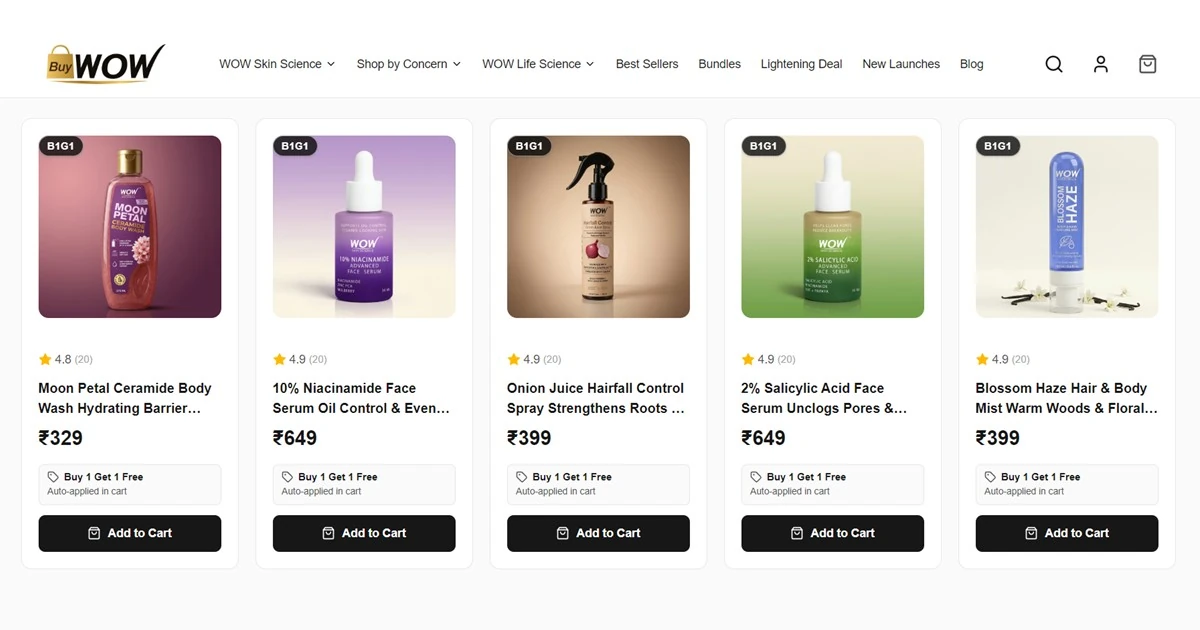
- Homepage Personalization: Homepage banners, featured collections, and promotional messaging adjusted according to observed visitor interests.
- Product Recommendations: Recommendation widgets continuously refreshed using behavioral insights instead of static bestseller lists.
- Adaptive Navigation: Frequently explored product categories became easier to access while less relevant options received lower visual priority.
- Personalized Calls-to-Action: CTA messaging evolved based on purchase intent. Examples included:
- Learn More
- Explore Ingredients
- Complete Your Routine
- Buy Now
- Limited-Time Offer
This adaptive user interface created a smoother customer journey with fewer unnecessary decision points.
Continuous Optimization Through AI Learning
Real-time personalization was supported by ongoing optimization rather than one-time implementation. Wow Skin Science’s publicly documented implementations with MoEngage highlight the use of AI-powered customer engagement, behavioral segmentation, customer journey orchestration, and real-time campaign optimization. These capabilities closely align with the execution framework discussed in this strategy analysis.
The optimization process included:
- Live A/B testing
- Continuous performance monitoring
- Conversion analysis
- Behavioral segmentation updates
- Predictive personalization refinement
- Customer journey optimization
As more visitor interactions accumulated, the personalization engine became increasingly effective at identifying intent and recommending appropriate experiences.
Growth Impact
The strategy aimed to improve multiple performance indicators across the ecommerce funnel.
| Performance Area | Expected Business Impact* |
|---|---|
| User Engagement | Higher session duration |
| Bounce Rate | Lower abandonment |
| Product Discovery | Increased interaction with recommendations |
| Conversion Rate | Higher purchase completion |
| Average Order Value | Improved through personalized cross-selling |
| Customer Retention | Better repeat purchase likelihood |
Wow Skin Science’s implementation of LimeChat’s GPT-powered AI assistant reportedly delivered a 23% improvement in conversions, increased customer support automation from 72% to 84%, and provided a 2× better customer experience, demonstrating the measurable impact of AI-driven personalization across customer interactions.
Estimated Performance Outcomes
The following figures represent realistic industry-level estimates for AI-driven real-time personalization and are illustrative rather than confirmed campaign results.
- Approximately 15–30% improvement in conversion rate
- Around 20–40% increase in engagement with personalized content
- Approximately 10–25% growth in average order value through relevant product recommendations
- Bounce rate reduction of roughly 10–20%
- Improved repeat visitor engagement due to more relevant shopping experiences
These outcomes align with commonly reported benefits of dynamic website personalization and AI-powered customer experience optimization across ecommerce environments.
Why This Strategy Worked
The campaign succeeded because personalization occurred while customers were actively browsing rather than before the session began.
Several execution principles contributed to its effectiveness:
- Behavioral signals replaced assumptions.
- AI continuously interpreted customer intent.
- UX adjustments reduced purchase friction.
- Personalized recommendations improved product relevance.
- Dynamic content kept experiences aligned with changing customer interests.
- Continuous optimization enhanced personalization accuracy over time.
Rather than creating one optimized website, the strategy effectively created thousands of individualized shopping experiences that adapted in real time.
Key Takeaways for Marketers
An effective AI Marketing Strategy extends beyond automation by enabling experiences that evolve alongside customer behavior. AI Personalization becomes significantly more impactful when behavioral insights influence interface elements, navigation, recommendations, and messaging during live sessions instead of relying on static audience definitions.
For ecommerce brands, especially within personal care, real-time UX adaptation can improve customer engagement, streamline decision-making, and support measurable business growth. The combination of first-party behavioral data, adaptive interfaces, predictive personalization, and continuous optimization provides a scalable framework for delivering more relevant digital experiences while increasing conversion efficiency.