Strategy Snapshot
Strategy: Micro-Segment Retargeting
Channel: Paid Social and Display Retargeting
Objective: Improve conversions using smart product suggestions
Core Idea: Ad copy dynamically changes based on user interest level
Execution: Lever AI-driven audience segmentation and personalized messaging
Primary Result: Higher CTR, improved conversion rates, reduced CPA
This strategy centered on deploying smart product suggestions through hyper-personalized ads, where messaging evolved based on real-time user intent signals. The approach moved beyond static retargeting into adaptive, behavior-driven engagement.
Market Challenge
Traditional retargeting campaigns often rely on broad segmentation, leading to repetitive ad exposure and declining engagement. Users at different stages of the decision journey were served identical creatives, resulting in poor message relevance and reduced conversion efficiency.
Additionally, the absence of interest-based ad copy limited the effectiveness of behavioral retargeting strategies. Without aligning messaging to user intent, even high-quality traffic failed to convert efficiently.
The core challenge was to operationalize smart product suggestions in a way that dynamically reflected user behavior, while maintaining scalability across paid media channels.
Strategy Execution
Audience Micro-Segmentation Framework
The foundation of execution was a refined audience segmentation strategy driven by behavioral data.
Users were categorized into micro-segments based on:
- Browsing depth and frequency
- Product interaction signals
- Time spent on specific categories
- Previous purchase or cart activity
This enabled predictive customer targeting, classifying users into:
- High-intent users ready to convert
- Mid-intent users exploring options
- Low-intent users in discovery phase
Dynamic Ad Personalization Engine
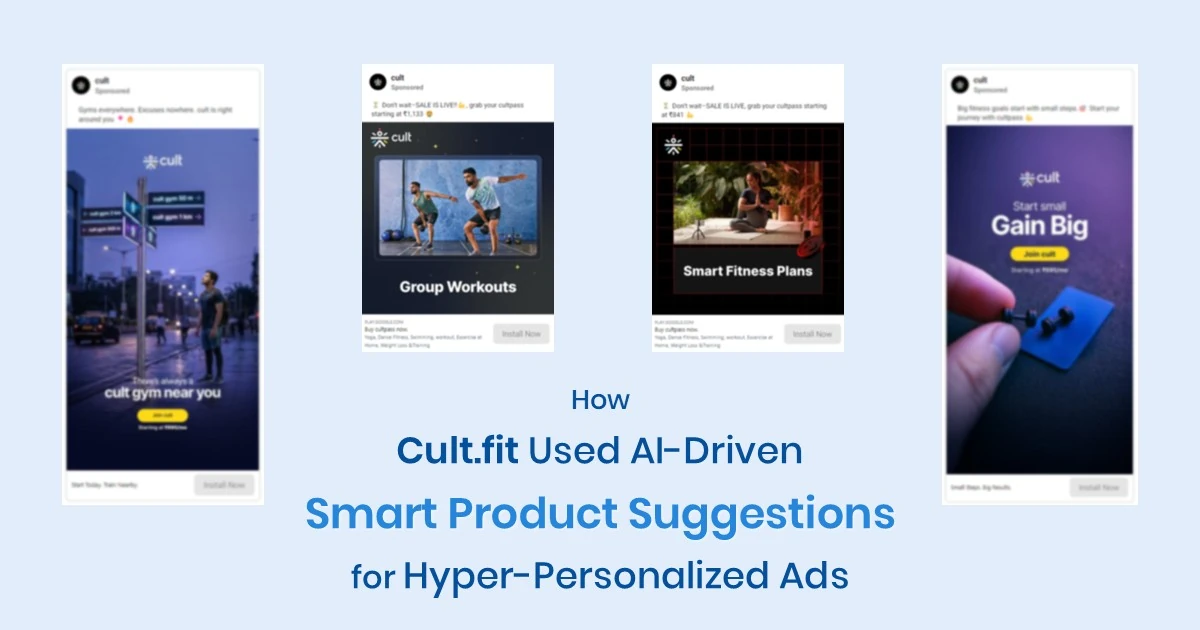
Instead of static creatives, the campaign deployed dynamic ad personalization where ad copy and visuals adapted to each segment.
Key execution elements:
- Smart product suggestions tailored to browsing behavior
- Real-time content adjustments based on user engagement
- Personalized value propositions aligned with intent stage
This ensured that each user saw messaging relevant to their current mindset, increasing ad resonance.
Messaging Architecture by Intent Level
Ad copy variation was the unique differentiator. Each segment received distinct messaging:
High-Intent Users
- Focus: urgency and conversion
- Messaging: limited-time offers, strong CTAs
- Example: “Complete your fitness plan today”
Mid-Intent Users
- Focus: benefits and differentiation
- Messaging: feature highlights, comparisons
- Example: “Find the plan that fits your lifestyle”
Low-Intent Users
- Focus: awareness and education
- Messaging: introductory content, brand value
- Example: “Start your fitness journey with expert guidance”
This interest-based ad copy framework ensured alignment with user psychology at every stage.
Channel Deployment and Delivery
The campaign leveraged multiple channels for scale and consistency:
- Paid social platforms for engagement-driven retargeting
- Display networks for high-frequency recall
- Cross-device tracking for seamless user experience
Sequential ad delivery ensured that users progressed through tailored messaging journeys rather than seeing repetitive creatives.
Continuous Optimization Loop
Execution was supported by a strong feedback system:
- A/B testing of creatives and messaging variants
- Performance tracking by micro-segment
- Budget reallocation based on conversion efficiency
This iterative approach enhanced conversion rate optimization ads, ensuring sustained performance improvements over time.
Results and Impact
The implementation of smart product suggestions combined with micro-segmentation led to measurable improvements across key metrics.
Performance Metrics (Estimated based on industry benchmarks)
| Metric | Estimated Improvement | Impact Driver |
|---|---|---|
| Click-Through Rate (CTR) | +25% to 40% | Interest-based ad copy aligned with user intent |
| Conversion Rate | +18% to 30% | Smart product suggestions and micro-segmentation |
| Cost Per Acquisition (CPA) | -15% to 25% | Improved targeting efficiency and reduced waste |
| Ad Relevance Score | Moderate to High Increase | Dynamic ad personalization |
| Repeat Visit Rate | +20% to 35% | Sequential retargeting and tailored messaging |
Engagement Metrics
- Higher ad relevance scores across platforms
- Increased repeat visits from retargeted users
- Improved session duration on landing pages
Business Impact
- Stronger ROI from paid media campaigns
- More efficient use of ad spend through precise targeting
- Enhanced scalability of AI-based product recommendations
The strategy demonstrated that aligning smart product suggestions with user intent significantly improves both efficiency and effectiveness of retargeting campaigns.
Key Insight
The success of this strategy lies in combining micro-segmentation with dynamic ad personalization. Instead of treating retargeting as a single-layer tactic, it becomes a multi-layered system where messaging evolves with user behavior.
For marketers, the key takeaway is clear:
- Smart product suggestions alone are not enough
- Their impact multiplies when paired with intent-driven segmentation and adaptive messaging
This approach transforms retargeting from repetitive exposure into a precision-driven conversion engine.