
Redefining Creativity: How Canva Transformed the Online Design Tool Landscape
Design once required expensive software and trained professionals. For small businesses and individuals, that meant high costs and slow execution. The market was waiting for a simple, accessible online design tool that removed those barriers.
Founded in 2013, Canva stepped in with a clear mission: democratize design. Instead of building for experts first, Canva focused on non-designers. The result was a browser-based platform built around drag and drop simplicity.
From Tool to Graphic Design Platform
Initially, Canva solved a straightforward problem. Make design easy. But it quickly expanded into a full graphic design platform supporting teams and businesses.
Key early advantages included:
- Ready-made templates for presentations, social media, and marketing
- Free access with premium upgrades
- Cloud based accessibility across devices
- Built-in collaborative design software features
This shift from a basic editor to a scalable platform allowed Canva to serve individuals, startups, educators, and enterprises alike.
Why the Timing Worked
As businesses moved toward cloud-first tools and remote collaboration, Canva’s online design tool fit naturally into modern workflows. Content demand was rising, and organizations needed faster, more affordable creative production.
| Factor | Canva’s Advantage |
|---|---|
| Ease of Use | No technical training required |
| Accessibility | Works entirely in the browser |
| Scalability | Suitable for individuals and enterprises |
Canva did not win by being more complex. It won by being more accessible. That philosophy became the foundation of its global growth.
The Problem: Why Traditional Graphic Design Was Broken
Before Canva entered the market, design software was powerful but intimidating. Most tools were built for professionals, not everyday users. That created a significant gap between people who needed design and those who could actually execute it.

The industry was optimized for expertise, not accessibility. As a result, businesses either hired designers or struggled with complex software that demanded weeks of learning.
The High Barrier to Entry
Legacy tools came with friction at every step. They required installation, hardware compatibility, and technical understanding. For non-designers, even creating a basic social media post felt overwhelming.
Common challenges included:
- Steep learning curves with professional interfaces
- Expensive software licenses and subscriptions
- Limited accessibility across devices
- Complex file management systems
- Minimal built-in collaboration features
This environment made traditional tools unsuitable for startups and small teams looking for speed and affordability.
The Cost Problem for Businesses
For growing companies, design was not optional. Marketing campaigns, sales presentations, social media posts, and branding assets were essential. But hiring full-time designers increased operational costs.
Startups often faced a dilemma:
- Outsource design and increase expenses
- Train internal staff on complex tools
- Compromise on quality
There was clear demand for design software for non designers that balanced simplicity with capability.
Collaboration Was an Afterthought
Most traditional tools were not built as collaborative design software. File sharing required emailing attachments or using third-party cloud storage. Real-time editing was rare, and version control often became chaotic.
As remote work increased and teams became more distributed, this lack of collaboration became a serious limitation.
The Enterprise Gap
Large organizations faced a different challenge. While they had access to professional tools, maintaining brand consistency across departments was difficult. There was no centralized, cloud based design platform that allowed marketing, HR, and operations teams to create on-brand materials without heavy oversight.
| Pain Point | Impact on Businesses |
|---|---|
| Complex software | Slower content production |
| High costs | Increased marketing expenses |
| Limited collaboration | Workflow inefficiencies |
| Skill dependency | Reduced agility |
The market did not just need better design features. It needed a simpler, scalable solution. This gap set the stage for Canva’s rise as an intuitive online design tool that prioritized usability over complexity.
The Vision: Building a Graphic Design Platform Anyone Could Use
When Canva launched, it was not trying to compete feature-for-feature with legacy design software. Instead, the vision was radically different. Make design simple enough for anyone, yet powerful enough for businesses.
The founders believed creativity should not be limited by technical skill. If spreadsheets and documents could move to the cloud and become collaborative, why not design? That thinking laid the foundation for a new kind of online design tool.
Rising Global Interest in Canva: Search Momentum Over Time
Google Trends data reveals a steady and sustained increase in global search interest for Canva over the past several years. What began as modest search activity has evolved into consistent upward momentum, with noticeable acceleration after 2022. This pattern signals more than brand awareness. It reflects growing demand for accessible creative tools as individuals, startups, educators, and enterprises increasingly rely on digital content. The upward trajectory supports Canva’s positioning as a leading online design tool and highlights its evolution into a widely adopted graphic design platform with expanding global relevance.
Designing for Non-Designers First
Most traditional software was built for professionals and later adapted for broader audiences. Canva flipped that model. It focused on usability from day one.
The core principles were clear:
- Drag and drop functionality instead of complex toolbars
- Templates that eliminate the blank-page problem
- Pre-set layouts for social media, presentations, and marketing materials
- Minimal learning curve
This approach positioned Canva as true design software for non designers while still offering enough flexibility for advanced users.
From Simplicity to Scalable Platform
As adoption grew, Canva expanded beyond being a simple editor. It started evolving into a comprehensive graphic design platform that could support teams and organizations.
Key strategic additions included:
- Brand kits to maintain visual consistency
- Real-time collaboration for teams
- Cloud-based storage and access
- Role-based permissions for businesses
This transformation allowed Canva to serve individuals, small businesses, and eventually enterprise clients without abandoning its simplicity-first philosophy.
The Freemium Strategy
Another critical part of the vision was accessibility through pricing. Canva introduced a freemium model that lowered entry barriers while monetizing power users and teams.
| Tier | Target Audience | Value Proposition |
|---|---|---|
| Free | Individuals & students | Core design capabilities |
| Pro | Creators & small businesses | Premium templates and assets |
| Teams / Enterprise | Organizations | Collaboration and brand control |
By removing financial friction, Canva accelerated adoption. Users could experience the value of the online design tool before committing to paid plans.
The vision was not just to build software. It was to democratize creativity at scale. And that clarity of purpose shaped every product and business decision that followed.
Product Strategy: What Makes Canva a Leading Online Design Tool
Canva’s growth did not happen by accident. Its product strategy was deliberate, focused, and deeply aligned with user behavior. Instead of overwhelming users with advanced features, Canva prioritized intuitive workflows and incremental expansion.
At its core, the company optimized for one outcome: reduce friction in visual creation. That clarity helped transform it from a simple editor into a globally adopted online design tool.
Simplicity at Scale
The foundation of Canva’s success lies in its user interface. It feels approachable even to first-time users.
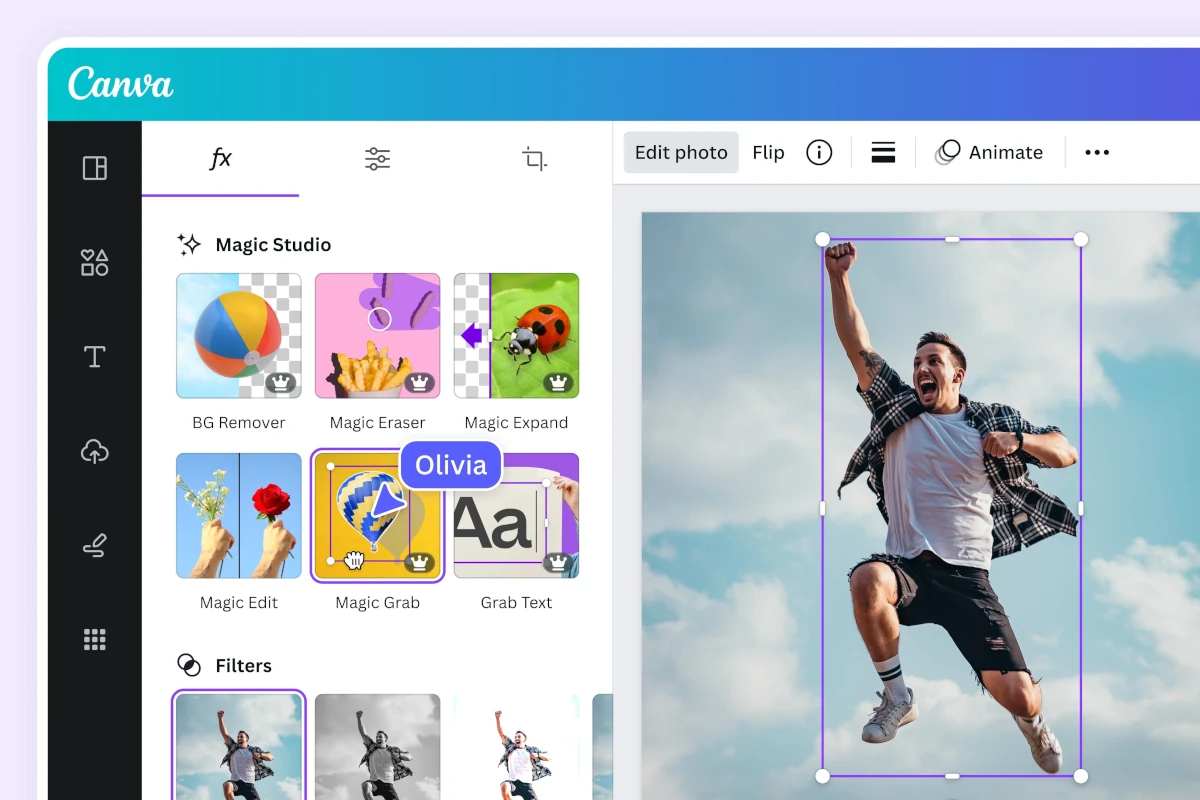
Key product strengths include:
- Drag and drop editing with visual controls
- Thousands of customizable templates
- Built-in stock photos, fonts, and design elements
- AI-powered features for resizing and content suggestions
By eliminating the blank canvas problem, Canva accelerated content creation. Users could start with structure and then personalize it, rather than building from scratch.
This design-first thinking made Canva appealing to entrepreneurs, educators, and marketers who needed speed without sacrificing quality.
Built-In Collaboration
As teams increasingly worked remotely, collaboration became essential. Canva responded by embedding collaborative design software capabilities directly into the product.
Users can:
- Edit designs in real time
- Leave comments and feedback
- Share folders across teams
- Control brand assets with centralized kits
This shift elevated Canva from an individual creator tool to a team-ready graphic design platform.
Cloud-Based Accessibility
Unlike traditional desktop software, Canva operates entirely in the browser. That decision was strategic.
Benefits of its cloud based design platform model include:
- No installation required
- Seamless updates without manual downloads
- Access from any device
- Easy integration with productivity tools
This accessibility reduced technical barriers and allowed organizations to scale creative production quickly.
Product Evolution Snapshot
| Capability | Individual Users | Teams | Enterprises |
|---|---|---|---|
| Templates | Yes | Yes | Yes |
| Real-time Collaboration | Limited | Yes | Yes |
| Brand Control | Basic | Advanced | Enterprise-level |
| Permissions & Admin Controls | No | Yes | Yes |
Canva’s product strategy balanced simplicity with scalability. It did not abandon beginners as it grew. Instead, it layered enterprise-grade capabilities on top of an intuitive foundation.
That balance is what turned Canva into more than just an online design tool. It became an ecosystem supporting creators, startups, and global organizations alike.
Monetization Engine: Breaking Down Canva’s Business Model
Behind Canva’s simple interface lies a carefully designed revenue strategy. The company understood early on that widespread adoption would come first. Monetization would follow once users experienced value.
Instead of restricting access, Canva used a freemium approach to turn its online design tool into a global entry point for individuals and businesses.
The Freemium Flywheel
Canva’s free tier removes friction. Anyone can sign up and start designing immediately. This creates scale, brand familiarity, and viral growth as users share designs externally.
The monetization layer is built on value expansion.
- Free plan for individuals and students
- Canva Pro for advanced creators and small businesses
- Canva Teams for collaboration
- Enterprise solutions for large organizations
By allowing users to grow within the ecosystem, Canva reduces churn and increases lifetime value.
Revenue Streams Explained
Canva’s revenue does not rely on one single channel. It is diversified across subscription tiers and asset usage.
| Revenue Stream | Description | Target Segment |
|---|---|---|
| Canva Pro | Premium templates, assets, and tools | Entrepreneurs, marketers |
| Canva Teams | Collaboration and shared brand kits | Small to mid-sized teams |
| Enterprise Plans | Advanced controls and security | Large organizations |
| Marketplace Assets | Paid design elements and stock media | All paid users |
This layered structure supports Canva’s evolution into a scalable graphic design platform while keeping the core experience accessible.
Why the Model Works
Several factors strengthen Canva’s monetization strategy:
- Low customer acquisition cost due to product-led growth
- Natural upgrade path as users’ needs expand
- Recurring subscription revenue model
- High retention driven by stored design assets and workflows
Once businesses integrate Canva into daily operations, switching becomes less attractive. Designs, brand kits, templates, and team processes are already embedded in the system.
The brilliance of Canva’s business model lies in balance. It protects accessibility while unlocking premium value. That balance allows the online design tool to serve individuals without limiting its enterprise potential.
Growth Flywheel: How Canva Scaled Its Online Design Tool Globally
Canva’s rise was not driven by aggressive advertising alone. Its growth engine was product-led, community-driven, and strategically localized. The company focused on making its online design tool easy to adopt, easy to share, and hard to replace.
Instead of pushing sales first, Canva let the product create its own momentum.
Product-Led Growth at the Core
From day one, Canva removed friction from onboarding. Users could sign up in minutes and begin designing immediately. No installations. No complicated tutorials.
This simplicity fueled organic growth through:
- Shareable design outputs with subtle Canva branding
- Free access lowering adoption barriers
- Templates tailored to trending content formats
- Continuous feature releases based on user feedback
Each shared presentation, social post, or infographic acted as indirect marketing for the platform.
Viral Loops and Community Expansion
Canva built natural virality into its ecosystem. When users collaborated or shared editable templates, others were invited into the platform.
Key growth levers included:
- Team invitations driving multi-user adoption
- Educational partnerships with schools and universities
- Nonprofit discounts encouraging mission-based organizations
- A growing creator marketplace contributing templates
This approach helped transform Canva from a single-user tool into a widely adopted graphic design platform across industries.
Localization and Global Reach
Unlike many startups that focus on a single region, Canva prioritized international expansion early. The platform supports multiple languages and region-specific templates.
This strategy enabled:
- Rapid adoption across Asia, Europe, and Latin America
- Strong penetration in emerging markets
- Increased accessibility for non-English speaking users
By lowering both technical and language barriers, Canva positioned itself as a truly global online design tool.
Growth Snapshot
| Growth Driver | Impact on Expansion |
|---|---|
| Freemium Model | Accelerated user acquisition |
| Collaboration Features | Increased team-based adoption |
| Localization | Expanded international footprint |
| Education Focus | Long-term brand loyalty |
Canva’s growth story highlights a key lesson. When the product itself delivers immediate value, marketing becomes amplification rather than persuasion.
Competitive Landscape: Canva vs Established Design Giants
As Canva scaled, it entered a market dominated by established players and fast-growing startups. The question was not whether Canva could compete feature-for-feature. The real question was whether its online design tool model could redefine user expectations.
Instead of positioning itself as a replacement for professional design suites, Canva carved out a new category focused on accessibility, collaboration, and speed.
Traditional Powerhouses
The most obvious competitor is Adobe, long considered the industry standard for professional design. Adobe’s tools offer deep customization and advanced editing capabilities, but they also come with complexity and higher costs.
Similarly, Figma emerged as a collaborative interface design leader, especially among product and UX teams. Its real-time collaboration model overlaps with Canva’s team features but serves a more specialized audience.
Even platforms within productivity ecosystems like Microsoft compete indirectly through tools such as PowerPoint and Publisher.
How Canva Differentiates Itself
Canva’s competitive edge lies in simplicity and breadth rather than technical depth.
Key differentiators include:
- Beginner-friendly interface
- Template-driven workflows
- Browser-based access with no installation
- Built-in collaboration for non-technical teams
- Affordable pricing tiers
Rather than targeting professional designers exclusively, Canva focuses on marketers, educators, entrepreneurs, and business teams.
Feature Comparison Snapshot
| Feature | Canva | Adobe | Figma |
|---|---|---|---|
| Ease of Use | Very High | Moderate to Complex | Moderate |
| Cloud-Based Access | Yes | Partial | Yes |
| Real-Time Collaboration | Yes | Limited | Strong |
| Template Ecosystem | Extensive | Limited | Minimal |
| Target Audience | Broad market | Professional designers | Product & UX teams |
This comparison highlights Canva’s positioning as a scalable graphic design platform built for mass adoption.
Competing on Accessibility, Not Complexity
Canva does not attempt to replicate every advanced feature found in legacy tools. Instead, it focuses on reducing friction for the majority of users who need fast, high-quality visuals without extensive training.
That strategy has allowed Canva’s online design tool to coexist with professional software rather than directly replace it.
Enterprise Expansion: From Creators to Corporations
Canva’s early success came from individuals and small teams. But long-term scalability required moving upmarket. The challenge was clear. How do you transform a simple online design tool into an enterprise-ready solution without losing usability?
Canva’s answer was strategic layering. Instead of redesigning the product, it added structured controls, governance features, and integrations on top of its intuitive foundation.
Canva Audience Demographics
Canva’s audience demographics reveal a female-majority user base, with women accounting for nearly 59 percent of total traffic. Age-wise, the platform is strongest among 25–34 year olds, followed closely by 18–24 and 35–44 segments. This concentration in working-age and early-career professionals reflects Canva’s positioning as a practical online design tool for entrepreneurs, marketers, and digital creators. The balanced presence across mid-age brackets further reinforces its broad adoption across both individual and business users.
Solving Enterprise Pain Points
Large organizations face different design challenges compared to individual users. Brand consistency, approval workflows, and access control become critical.
Canva addressed these through:
- Centralized brand kits with approved logos, fonts, and color palettes
- Role-based permissions for teams
- Admin dashboards for usage oversight
- Template locking to maintain compliance
- Integration with productivity and storage platforms
These additions positioned Canva as more than just a creator tool. It became a scalable graphic design platform capable of supporting distributed teams.
Why Enterprises Adopted Canva
Traditional enterprise design workflows often rely on specialist software and dedicated creative departments. This can slow down non-design teams such as HR, sales, or internal communications.
Canva introduced flexibility by enabling:
- Marketing teams to scale campaign assets quickly
- HR departments to design internal materials without external agencies
- Sales teams to customize presentations in minutes
- Regional offices to localize branded content efficiently
This model empowers non-designers while preserving brand control.
Enterprise Value Proposition Snapshot
| Enterprise Need | Canva’s Solution |
|---|---|
| Brand Consistency | Centralized brand kits |
| Workflow Efficiency | Real-time collaboration |
| Access Control | Admin and permission settings |
| Scalability | Cloud based infrastructure |
By maintaining simplicity while adding governance, Canva successfully expanded beyond startups and positioned its online design tool as enterprise-ready.
Results & Market Impact: Measuring Canva’s Global Influence
Canva’s evolution from a simple online design tool to a globally adopted platform is reflected in its scale, valuation, and product expansion. What began as a solution for non-designers has become a core creative infrastructure for individuals, startups, and enterprises.
The numbers tell a compelling story.
User Growth and Global Adoption
Over the years, Canva has experienced rapid international expansion. Its accessibility, freemium model, and collaborative capabilities fueled adoption across industries.
Key growth indicators include:
- Presence in more than 190 countries
- Millions of monthly active users worldwide
- Strong adoption across education and nonprofit sectors
- Enterprise partnerships with global brands
This widespread usage reinforces Canva’s positioning as a scalable graphic design platform, not just a consumer-facing tool.
Revenue and Valuation Momentum
Canva User Growth & Revenue (2019–2025)
Canva’s rise from a startup to a globally recognized design platform demonstrates how product accessibility and a scalable business model can reshape an entire industry. Over the past six years, the company’s monthly active users surged from under 30 million to roughly 260 million worldwide, while annual revenues climbed past $3.5 billion by 2025. A steadily expanding global presence, coupled with a freemium subscription strategy and high enterprise adoption, has positioned Canva as a dominant force in visual content creation tools. Its valuation, exceeding $40 billion as of 2025, reflects strong investor confidence and a commitment to evolving into a comprehensive graphic design ecosystem.
These figures are based on publicly available disclosures, company announcements, and reputable industry reports, as Canva does not release consolidated audited financial statements.
As user adoption increased, monetization followed. Canva’s subscription-based model generated recurring revenue while maintaining accessibility.
Growth highlights include:
- Expansion of Canva Pro and Teams subscriptions
- Enterprise revenue growth driven by organizational adoption
- Significant valuation milestones reflecting investor confidence
The balance between free access and premium upgrades strengthened long-term retention and recurring revenue streams.
Global Audience Distribution
Canva’s global traffic distribution highlights its strong international adoption beyond the United States. While the U.S. contributes over 17 percent of total web traffic, emerging markets such as Brazil, Indonesia, India, and the Philippines collectively represent a significant share of engagement. Notably, more than half of total traffic comes from “Other” countries, demonstrating Canva’s diversified global footprint. This broad geographic spread reinforces its positioning as a scalable online design tool rather than a region-specific product, supporting sustained growth across developed and emerging digital economies.
Product Impact Across Segments
Canva’s online design tool has influenced how different groups approach content creation.
| Segment | Impact |
|---|---|
| Entrepreneurs | Faster brand creation without agencies |
| Marketing Teams | Scalable campaign asset production |
| Educators | Accessible classroom design tools |
| Enterprises | Brand consistency across departments |
The platform reduced dependency on specialized software for everyday design tasks, allowing teams to operate more independently.
Industry-Level Influence
Beyond company metrics, Canva shifted industry expectations. Simplicity, cloud access, and collaboration are no longer optional features. They are standard requirements.
Its success demonstrated that:
- Design software does not need to be complex to be powerful
- Accessibility can coexist with scalability
- Freemium models can support enterprise expansion
Canva did not just grow within the market. It reshaped the market’s expectations of what an online design tool and modern graphic design platform should deliver.
SWOT Analysis: Evaluating Canva’s Strategic Position
As Canva matured from a startup into a global online design tool, its strengths and risks became more visible. A structured SWOT analysis helps clarify where the company stands today and what could influence its future trajectory.
| SWOT Element | Strategic Implication |
|---|---|
| Strengths | Strong user acquisition and retention |
| Weaknesses | Limited dominance in high-end professional design |
| Opportunities | AI and enterprise expansion |
| Threats | Competitive pressure from established and emerging platforms |
Strengths
Canva’s competitive advantages are deeply rooted in accessibility and scalability.
- Intuitive drag and drop interface
- Strong global brand recognition
- Freemium model driving large user base
- Built-in collaboration features
- Cloud based infrastructure supporting remote teams
- Expanding ecosystem of templates and integrations
Its simplicity-first approach continues to differentiate it from more complex professional tools.
Weaknesses
Despite its growth, Canva faces certain structural limitations.
- Limited advanced editing compared to professional-grade software
- Dependency on internet access due to browser-based model
- Risk of being perceived as a beginner-focused tool
- Heavy competition in design and productivity markets
While it operates as a full graphic design platform, some professional designers still rely on specialized software for high-end projects.
Opportunities
The market for visual content continues to expand rapidly, creating strong growth potential.
- AI-driven automation and content generation
- Deeper enterprise integrations
- Expansion into video, presentations, and document workflows
- Growth in emerging markets
- Industry-specific template ecosystems
As businesses increase digital content output, demand for scalable design tools is likely to grow.
Threats
Canva operates in a competitive and evolving landscape.
- Established players enhancing collaboration features
- New startups offering niche design solutions
- Price competition within subscription-based models
- Security and compliance demands from enterprise clients
Overall, Canva’s position remains strong due to its clear value proposition and global reach. However, sustaining growth will require balancing simplicity with increasing enterprise expectations.
Conclusion & Key Takeaways: The Future of the Online Design Tool Economy
Canva’s journey illustrates how simplicity can disrupt even the most established industries. By focusing on accessibility instead of complexity, Canva transformed from a startup idea into a globally recognized online design tool used by individuals, startups, and enterprises alike.
What makes this story compelling is not just growth. It is positioning. Canva did not attempt to replace every professional tool overnight. Instead, it built a user-friendly foundation and expanded strategically into a full graphic design platform with collaboration, governance, and enterprise-grade capabilities layered on top.
The result is a product that scales across user segments without losing its core identity.
Key Takeaways for Businesses
Canva’s success offers practical lessons for founders, product leaders, and marketers.
- Solve accessibility gaps in complex industries
- Prioritize user experience before feature expansion
- Use freemium models to drive adoption at scale
- Build collaboration into the core product, not as an add-on
- Layer enterprise features without sacrificing simplicity
- Let product-led growth reduce marketing dependency
These principles apply beyond design software. They reflect a broader shift toward cloud based, collaborative platforms that reduce friction and empower non-specialists.
Strategic Lessons from Canva’s Growth
| Lesson | Business Insight |
|---|---|
| Democratization Wins | Simplifying complex tools expands market size |
| Product-Led Growth | Great products become marketing engines |
| Scalability Through Layers | Add complexity gradually as users grow |
| Ecosystem Thinking | Platforms outperform single-purpose tools |
Canva’s long-term success will depend on how effectively it integrates AI, deepens enterprise partnerships, and expands beyond static design into broader content workflows. But its foundation remains strong.
The company proved that an online design tool can evolve into a global creative infrastructure. And in doing so, it reshaped expectations for what a modern graphic design platform should deliver in a digital-first world.