Introduction: How Subscriptions Reshaped E-commerce Loyalty
E-commerce has evolved from one-time transactions to long-term customer relationships, with subscriptions playing a central role in this shift. Instead of relying solely on discounts or convenience, brands now use recurring value to build loyalty, increase engagement, and improve customer lifetime value.
Amazon led this transformation through Prime, redefining what consumers expect from online shopping. By bundling fast shipping with digital services, Amazon turned loyalty into a habit rather than a reaction to price or promotions.
The amazon prime business model shows how subscriptions can convert occasional shoppers into committed members by reducing friction and increasing perceived value. This approach reflects the broader ecommerce subscription model, where consistency, convenience, and ecosystem benefits outperform traditional loyalty programs.
This case study examines how Amazon Prime reshaped e-commerce loyalty and why its subscription-led strategy continues to set the benchmark for sustainable growth in digital commerce.
Amazon’s Evolution: From Online Store to Subscription Ecosystem
Amazon started as a traditional online retailer, with growth driven by product variety, competitive pricing, and reliable delivery. In its early years, customer loyalty was mainly transactional, shaped by convenience rather than long-term attachment.
As competition intensified, Amazon realized that price and speed alone were no longer sustainable differentiators. This prompted a strategic shift toward building recurring relationships and increasing customer lifetime value. The launch of Prime marked this turning point, reframing shipping from a cost burden into a loyalty-building benefit.
The amazon prime business model evolved from this shift, using subscriptions as the foundation for deeper engagement. Over time, Prime expanded beyond shipping into a broader ecosystem, aligning closely with the ecommerce subscription model, where retention, habit formation, and continuous value drive long-term growth.
Amazon’s Strategic Evolution Timeline (Visual Overview)
The timeline visually explains how Amazon evolved from a transactional retailer into a subscription-led ecosystem.
- Online Retail Foundation: Amazon focused on selection, pricing, and basic fulfillment.
- Logistics & Scale Expansion: Heavy investment in delivery speed and infrastructure.
- Amazon Prime Subscription Launch: Shipping became a loyalty driver through membership.
- Ecosystem & OTT Integration: Prime evolved into a bundled subscription supporting commerce, content, and retention.
This timeline sets the foundation for the next sections, where the amazon prime business model is analyzed in detail, including how shipping and OTT services work together to strengthen e-commerce loyalty.
Market Context: Subscription Economy Meets Digital Commerce
The global shift toward subscriptions has reshaped how consumers interact with digital products and services. From entertainment and software to retail and logistics, subscriptions have become a preferred way to access value continuously rather than through one-time transactions. This change is driven by convenience, predictability, and the growing expectation that services should adapt to ongoing needs.
In e-commerce, this shift marked a significant departure from traditional buying behavior. Shoppers no longer evaluate each purchase in isolation. Instead, they assess the overall value of belonging to a platform or ecosystem. Subscriptions reduce decision fatigue, encourage repeat usage, and create a psychological commitment that strengthens brand loyalty over time.
Several macro trends accelerated the rise of subscription-led digital commerce:
- Increased comfort with recurring digital payments
- Demand for faster delivery and instant access
- Growth of bundled services offering perceived savings
- Rising competition pushing brands to focus on retention
Within this environment, the ecommerce subscription model emerged as a strategic response to mounting pressure on margins and customer acquisition costs. Rather than constantly reacquiring customers, brands began prioritizing lifetime value, engagement frequency, and churn reduction. Subscriptions provided a structural way to achieve all three.
Unlike traditional loyalty programs, subscription models introduce a financial and emotional commitment upfront. Customers who pay for access are more likely to maximize usage, justify their spend, and remain loyal to the platform. This behavioral shift plays a critical role in digital commerce, where switching costs are otherwise low.
Subscription Economy vs Traditional E-commerce Loyalty
| Aspect | Traditional E-commerce | Subscription-Led Commerce |
|---|---|---|
| Purchase behavior | Occasional, need-based | Habitual, recurring |
| Loyalty driver | Discounts and promotions | Ongoing value and access |
| Revenue predictability | Low | High |
| Customer relationship | Transactional | Long-term engagement |
| Churn risk | High | Lower due to commitment |
This broader market context explains why subscription-first strategies gained momentum across industries. It also clarifies why models built around speed, convenience, and bundled value scale more effectively than those relying solely on pricing tactics.
Against this backdrop, the amazon prime business model stands out not just as a subscription offering, but as a fully integrated response to changing consumer expectations. By aligning digital commerce with subscription psychology, Amazon positioned itself to benefit from both behavioral loyalty and structural market shifts, setting the stage for deeper analysis in the sections ahead.
Understanding the Amazon Prime Business Model
The amazon prime business model is built around a simple idea with far-reaching impact: charge a recurring fee upfront and remove friction from everyday purchasing decisions. Instead of optimizing for individual transactions, Amazon designed Prime to increase engagement, frequency, and long-term customer value across its entire ecosystem.
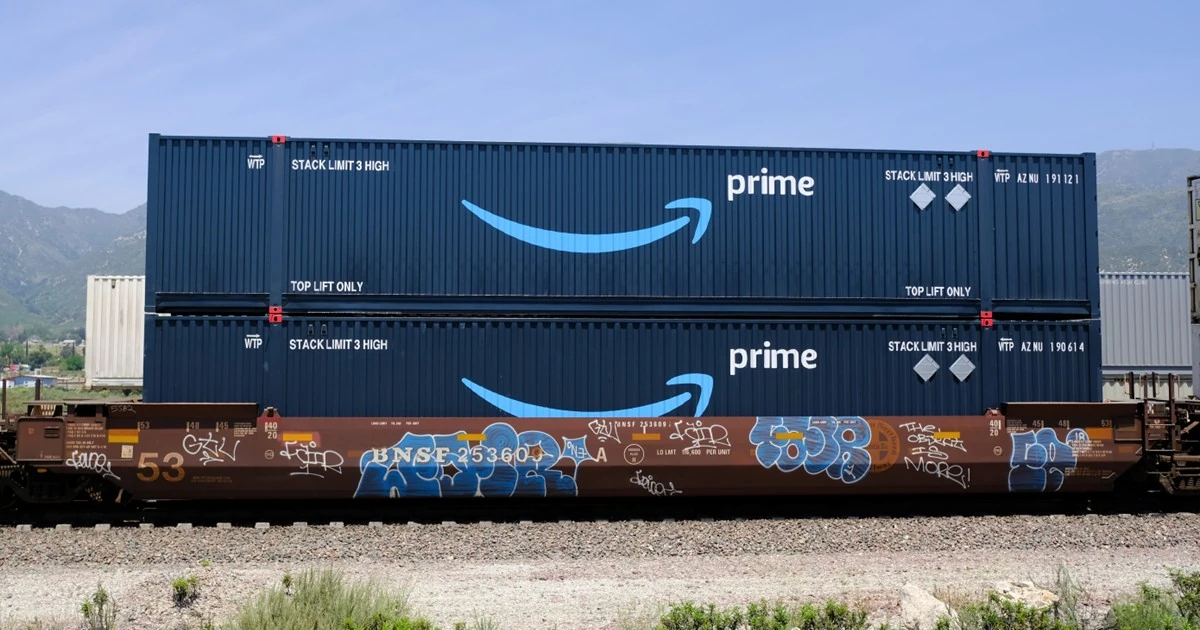
At its core, Prime transforms shipping, content, and services into a bundled value proposition. Members do not evaluate each benefit in isolation. The combined experience makes the subscription feel indispensable, even if individual features are used unevenly.
What Amazon Prime Includes
Prime is structured as a multi-benefit membership rather than a single-purpose subscription. The most visible components include:
- Free and fast shipping on eligible products
- Same-day or next-day delivery in select regions
- Access to Amazon Prime Video and original content
- Exclusive deals, early access to sales, and member-only pricing
- Additional digital services such as music, gaming, and reading benefits
This bundling strategy increases perceived value while lowering churn. Customers who might initially subscribe for shipping often remain because of entertainment or exclusive access, and vice versa.
Revenue Logic Behind Prime
Unlike traditional retail models that depend heavily on margins per order, Prime monetizes loyalty itself. Revenue is generated through:
- Annual or monthly membership fees
- Higher purchase frequency among members
- Increased average order value
- Cross-selling across multiple Amazon categories
By securing revenue upfront, Amazon offsets high fulfillment costs and reinvests aggressively in logistics and content. This reinforces the ecosystem and makes the membership more valuable over time.
Prime vs a Standard E-commerce Model
The table below highlights how Prime differs from a conventional e-commerce approach.
| Dimension | Standard E-commerce | Amazon Prime Model |
|---|---|---|
| Customer commitment | Low | High due to subscription |
| Shipping strategy | Cost center | Loyalty and value driver |
| Purchase frequency | Irregular | Consistently higher |
| Revenue predictability | Limited | Strong recurring base |
| Switching behavior | Easy | Reduced by ecosystem lock-in |
Why the Model Works at Scale
The success of the amazon prime business model is closely tied to its scale and integration. As more customers join Prime, Amazon gains:
- Better demand forecasting
- Higher utilization of logistics infrastructure
- Stronger negotiating power with sellers and partners
- More data to personalize shopping and content experiences
These advantages compound over time, making it difficult for competitors to replicate the model without comparable scale or ecosystem depth.
Viewed through the lens of the broader ecommerce subscription model, Prime is not just a loyalty program. It is a structural growth engine that aligns customer behavior with Amazon’s long-term strategic goals, setting the foundation for the shipping and OTT flywheel explored in the next sections.
Amazon Prime as an OTT Platform and Its Strategic Role
While fast shipping is often seen as the core benefit of Prime, Amazon’s OTT offering plays a critical but less visible role in strengthening the overall subscription ecosystem. Amazon Prime Video is not designed to compete with standalone streaming platforms on content volume alone. Instead, it functions as a strategic retention and engagement layer within the amazon prime business model.
Unlike pure entertainment subscriptions, Prime Video exists to keep users consistently connected to Amazon. Watching a series, discovering new originals, or returning for live sports creates frequent touchpoints that go beyond shopping. These interactions deepen brand familiarity and make the Prime membership feel valuable even during periods of low purchasing activity.
How Prime Video Strengthens the Prime Ecosystem
Prime’s OTT strategy works because it complements commerce rather than operating in isolation. Its impact can be seen across multiple dimensions:
- Increases daily or weekly engagement with the Amazon brand
- Reduces perceived cost of Prime by adding entertainment value
- Keeps members active even when they are not shopping
- Encourages long-term subscription retention
This approach aligns closely with subscription psychology. When users feel they are “getting their money’s worth” through content consumption, shipping benefits begin to feel free, even though they are central to the value proposition.
Amazon Prime Video vs Netflix: A Strategic Comparison
To understand why Amazon’s OTT strategy is different, it helps to compare it with Netflix, a platform built exclusively around entertainment.
| Aspect | Amazon Prime Video | Netflix |
|---|---|---|
| Primary objective | Support commerce and retention | Monetize entertainment |
| Role in ecosystem | Part of a bundled subscription | Standalone service |
| Revenue dependency | Indirect through Prime membership | Direct subscription fees |
| User engagement outcome | Drives shopping and loyalty | Drives viewing time only |
| Switching cost | High due to ecosystem | Lower due to single-purpose use |
Netflix focuses on maximizing watch time and content consumption, whereas Prime Video focuses on minimizing churn across the entire Prime ecosystem. The success of Prime Video is not measured only by hours watched but by how effectively it reinforces shipping usage, shopping frequency, and membership renewal.
Why Amazon Prime’s OTT Model Is Harder to Replicate
The advantage of Prime’s OTT integration lies in its ability to subsidize content through commerce. Amazon can invest heavily in original programming and live sports without relying solely on entertainment revenue. This flexibility allows Prime Video to serve as a long-term retention tool rather than a profit-maximization product.
From the perspective of the ecommerce subscription model, this makes Prime Video a strategic asset rather than a cost center. Content builds emotional engagement, shipping delivers functional value, and together they create a subscription experience that is deeply embedded in consumers’ daily lives.
By integrating OTT into its broader ecosystem, Amazon transformed Prime into more than a shipping program or a streaming service. It became a multi-purpose subscription where entertainment quietly fuels commerce, setting the stage for the flywheel effect explored in the next section.
The Flywheel Effect: OTT → Prime Shipping → E-commerce Growth
One of the most powerful outcomes of the amazon prime business model is the flywheel it creates between entertainment, logistics, and commerce. Rather than operating as separate benefits, Prime Video, fast shipping, and e-commerce reinforce each other in a continuous loop that strengthens customer loyalty and increases lifetime value.
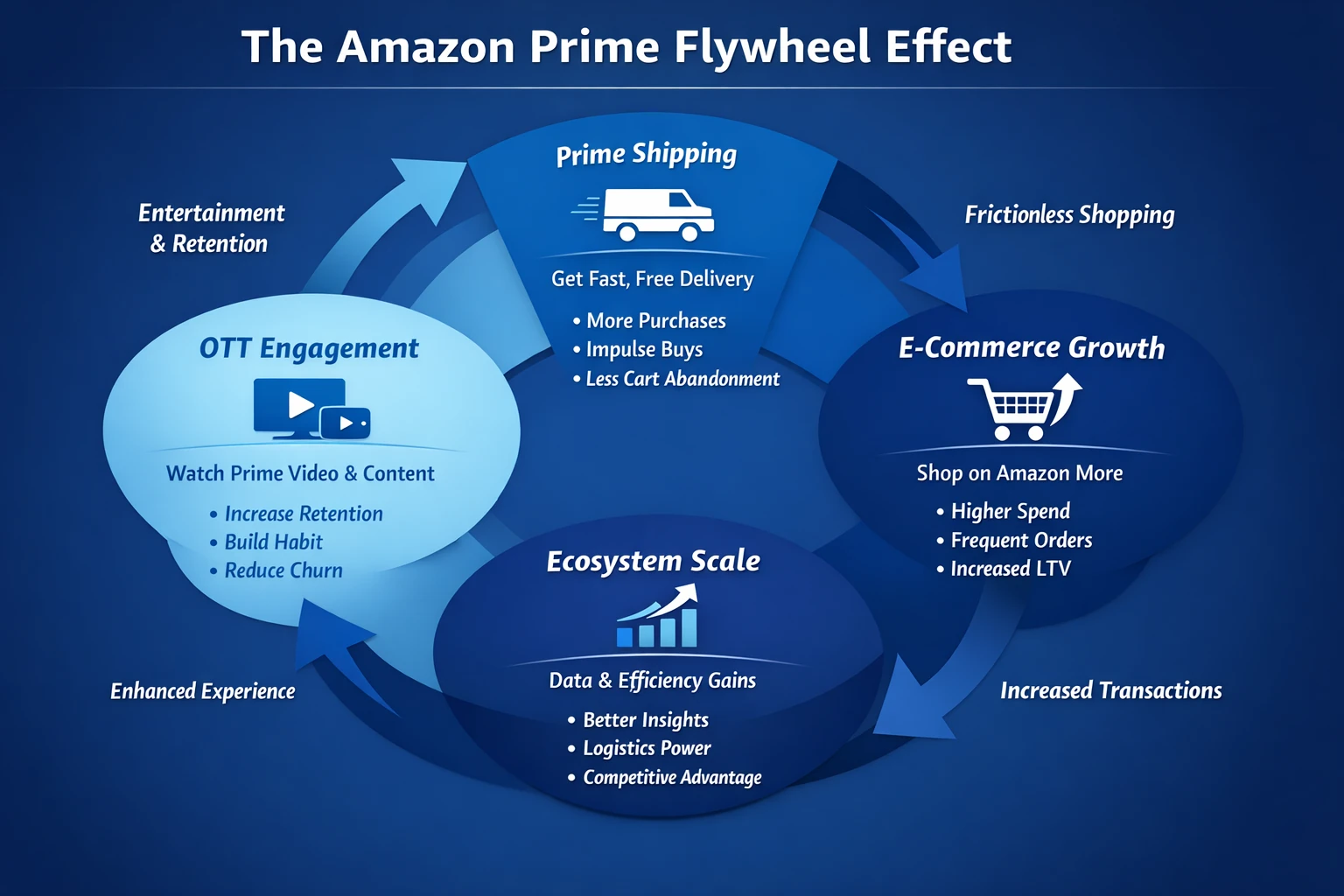
The flywheel begins with OTT engagement. When members regularly consume content through Prime Video, Amazon stays top of mind even outside shopping moments. This frequent exposure builds familiarity and emotional connection, making the platform feel like part of everyday life rather than just a place to buy products.
How OTT Activates the Amazon Prime Flywheel
OTT acts as the entry point for engagement, especially during periods when customers are not actively purchasing. Its role in the flywheel includes:
- Creating habitual, repeat interactions with the Amazon brand
- Justifying the Prime subscription fee through entertainment value
- Reducing churn by increasing perceived membership utility
- Keeping users inside the Amazon ecosystem year-round
Once customers feel invested in the subscription, they are more likely to maximize its benefits. This is where fast shipping becomes critical.
Amazon Prime Shipping as the Commerce Accelerator
With shipping costs effectively prepaid through the subscription, members experience little friction at checkout. Free and fast delivery changes purchasing behavior in several ways:
- Encourages impulse and low-value purchases
- Increases order frequency across categories
- Reduces cart abandonment
- Builds trust in delivery reliability
Shipping, in this context, is no longer just a convenience feature. It becomes the mechanism that converts engagement into transactions.
From Shipping to E-commerce Growth
As members shop more frequently, Amazon benefits from higher data visibility, improved demand forecasting, and better utilization of its logistics network. This leads to faster fulfillment, better recommendations, and improved customer experience, which further strengthens OTT engagement and subscription retention.
The flywheel can be summarized as follows:
| Flywheel Stage | Primary Role | Business Impact |
|---|---|---|
| OTT Engagement | Retention and habit formation | Lower churn |
| Prime Shipping | Friction reduction | Higher order frequency |
| E-commerce Usage | Transaction growth | Increased lifetime value |
| Ecosystem Scale | Data and efficiency gains | Competitive moat |
From the perspective of the ecommerce subscription model, this flywheel is what separates Prime from most retail subscriptions. Instead of relying on a single benefit, Amazon built a system where each component amplifies the others.
By aligning entertainment, logistics, and commerce into one reinforcing loop, Amazon created a self-sustaining growth engine. This flywheel explains why Prime members shop more, stay longer, and remain deeply embedded in the ecosystem, setting the foundation for Amazon’s long-term dominance in subscription-led e-commerce.
Amazon Prime vs Traditional E-commerce Subscription Models
Most e-commerce subscriptions are built around a single promise. Faster delivery, exclusive discounts, or product replenishment. While these models can improve retention in the short term, they often struggle to create lasting differentiation. The amazon prime business model stands apart because it was never designed as a narrow subscription. It was built as a multi-layered ecosystem.
Traditional e-commerce subscriptions usually treat shipping or discounts as standalone incentives. Customers subscribe to save money or gain convenience, but the relationship remains largely functional. When a better deal appears elsewhere, switching costs are low and churn becomes a recurring challenge.
Amazon Prime approaches subscriptions differently. Instead of asking customers to justify a recurring fee repeatedly, it embeds value across multiple daily behaviors. Shopping, watching content, accessing deals, and even entertainment are all tied to a single membership. This integration changes how customers perceive value and commitment.
Core Differences in Subscription Design
The contrast between Prime and conventional e-commerce subscriptions becomes clear when viewed side by side.
| Dimension | Traditional E-commerce Subscription | Amazon Prime Model |
|---|---|---|
| Primary benefit | Shipping or discounts | Bundled ecosystem value |
| Engagement frequency | Purchase-driven | Daily or weekly touchpoints |
| Emotional connection | Low | High due to content and habit |
| Switching cost | Low | High due to ecosystem lock-in |
| Retention driver | Price savings | Convenience, habit, and access |
Most ecommerce subscription models rely heavily on rational value calculations. Customers stay subscribed as long as the math works. Prime, by contrast, blends rational and emotional value. Even if shipping savings fluctuate, content consumption, exclusive access, and habitual use keep the membership relevant.
Why Traditional Models Struggle to Compete
Shipping-only or discount-based subscriptions face structural limitations:
- Benefits are easy for competitors to replicate
- Engagement drops during low purchase periods
- Limited ability to justify price increases
- Weak emotional attachment to the brand
Without frequent engagement outside transactions, these models depend heavily on promotions to retain users. This increases margin pressure and reduces long-term sustainability.
Prime’s Structural Advantage
Prime’s advantage lies in how deeply it integrates into customer routines. OTT consumption keeps members engaged even when they are not shopping. Prime Shipping removes friction when they do decide to purchase. Together, these elements reinforce each other and support the broader ecommerce subscription model at scale.
Rather than competing feature by feature, Amazon redefined what an e-commerce subscription could be. Prime is not just a benefit layer added to shopping. It is the operating system that connects engagement, logistics, and commerce into a single, self-reinforcing model. This structural difference explains why Prime continues to outperform traditional e-commerce subscriptions and why it remains difficult to replicate.
Results and Outcomes: How Amazon Prime Translates Loyalty into Measurable Growth
The impact of Prime is best understood by looking at outcomes that sit directly at the intersection of subscriptions, shipping, and customer behavior. Rather than treating Prime as a standalone program, Amazon has embedded it into the core of its commercial engine. The results show how the amazon prime business model converts engagement into scale, frequency, and long-term value.
Prime Subscriber Growth as the Foundation
Prime’s first and most important outcome is scale. Over time, Amazon transformed Prime from a niche shipping program into a global subscription with hundreds of millions of members. The estimated Prime subscriber growth chart illustrates this steady expansion, reinforcing Prime’s role as a long-term retention vehicle rather than a short-term promotion.
Subscriber growth matters because it sets the foundation for every other Prime outcome. A larger member base creates more prepaid commitment, more frequent usage of shipping and OTT benefits, and a broader audience for Amazon’s ecosystem. This scale allows Amazon to invest aggressively in logistics speed and content without relying on per-transaction profitability.
Revenue Outcomes: Commerce and Subscriptions Growing Together
Online Stores revenue reflects how Prime Shipping accelerates commerce. As shipping friction disappears, members shop more often, place smaller and more frequent orders, and default to Amazon for everyday needs. The steady rise in Online Stores revenue over time aligns closely with Prime’s expansion and faster delivery promises.
Subscription Services revenue captures the direct monetization of Prime itself, including membership fees and OTT offerings such as Prime Video. Its consistent upward trajectory demonstrates that Prime is not only a cost center supporting retail, but also a growing revenue stream in its own right.
Shipping Speed and Order Frequency Outcomes
Beyond revenue, Prime has reshaped how often customers interact with Amazon. Recent Prime-focused disclosures show that members place orders far more frequently than non-members, often multiple times per week. Same-day and next-day delivery volumes now reach billions of items annually, signaling that speed is no longer an exception but a default expectation within the Amazon Prime ecosystem.
This behavior has two important outcomes:
- Higher order frequency improves utilization of Amazon’s fulfillment network
- Faster inventory turns support better forecasting and operational efficiency
Prime Shipping, in this sense, does not just serve customers faster. It restructures demand in a way that benefits Amazon’s cost structure at scale.
OTT’s Contribution to Retention and Stability
OTT usage does not show up directly in retail revenue charts, but its impact is visible in retention and subscription durability. Prime Video and other content benefits keep members engaged even when their shopping activity temporarily slows. This stabilizes subscription revenue and reduces churn, especially in mature markets.
As a result, Prime’s outcomes are not seasonal or promotion-driven. They are continuous, supported by entertainment-driven engagement that smooths usage across the year.
Summary of Prime-Led Outcomes
| Outcome Area | Observable Result |
|---|---|
| Subscriber growth | Large, durable Prime member base |
| Commerce impact | Higher order frequency and Online Stores revenue |
| Subscription revenue | Steady growth in Prime and OTT monetization |
| Delivery performance | Billions of same/next-day deliveries |
| Customer behavior | Habitual, default shopping behavior |
Interpreting the Results
Taken together, these outcomes confirm that Prime is not optimized for short-term margin efficiency. It is optimized for lifetime value, frequency, and habit formation. Subscriber growth fuels shipping usage. Shipping usage fuels commerce revenue. OTT sustains engagement and retention. Each outcome reinforces the next.
This results-driven view explains why the amazon prime business model continues to scale even as competitors match individual features. Prime succeeds because it delivers measurable outcomes across subscriptions, shipping, and commerce at the same time, turning loyalty into one of Amazon’s most powerful growth assets.
Data-Driven Impact of OTT on the Amazon Prime Business Model
OTT is often perceived as a supporting feature of Prime, but data patterns show that it plays a meaningful role in strengthening the overall subscription ecosystem. Within the amazon prime business model, Prime Video functions as a usage amplifier. It increases engagement frequency, stabilizes retention, and indirectly boosts e-commerce activity.
The key impact of OTT is not limited to viewership metrics. Its real value lies in how it changes member behavior over time. Prime members who actively use Prime Video tend to interact with Amazon more frequently across the year, even during periods when their shopping activity would otherwise decline.
OTT as a Retention and Engagement Lever
Prime Video introduces non-transactional engagement into the subscription. This matters because churn in e-commerce subscriptions often occurs during low purchase cycles. OTT fills those gaps.
From a behavioral standpoint, Prime Video contributes to:
- Higher monthly engagement frequency
- Lower likelihood of subscription cancellation
- Stronger perceived value of Prime membership
- Increased justification of the annual fee
Members who watch content regularly are less likely to question the cost of Prime, even if their shipping usage fluctuates.
Correlation Between OTT Usage and Commerce Activity
While Amazon does not disclose granular user-level data publicly, industry analyses consistently show clear directional trends between content usage and shopping behavior among Prime members.
| Metric Trend | Prime Members Using OTT | Prime Members Not Using OTT |
|---|---|---|
| Subscription retention | Higher | Lower |
| Annual engagement touchpoints | Frequent | Sporadic |
| Order frequency | Higher | Moderate |
| Perceived membership value | Strong | Price-sensitive |
OTT increases the number of reasons a customer has to stay inside the Prime ecosystem. More reasons lead to more usage. More usage leads to higher lifetime value.
OTT’s Indirect Revenue Impact
Amazon Prime Video does not need to outperform standalone streaming platforms on direct monetization to be successful. Its contribution is indirect but strategically significant.
OTT supports revenue growth by:
- Reducing churn and increasing subscription tenure
- Encouraging more frequent shopping through ecosystem familiarity
- Supporting higher tolerance for price increases
- Increasing exposure to Amazon’s broader product and service portfolio
In this sense, content investment acts as a retention subsidy for shipping and commerce. The cost of OTT is partially offset by incremental e-commerce revenue generated through higher member activity.
Why OTT Strengthens the Subscription Economics
From the perspective of the ecommerce subscription model, OTT improves the economics of Prime by smoothing engagement across time. Shipping demand is episodic. Entertainment consumption is habitual. When combined, they stabilize the subscription’s perceived value.
This balance allows Amazon to:
- Invest aggressively in logistics and content
- Maintain high renewal rates
- Scale Prime without relying solely on retail margins
Strategic Advantages Created by OTT Integration
Integrating OTT into Prime created strategic advantages that go far beyond entertainment. Within the amazon prime business model, content is not a standalone growth driver. It is a force multiplier that strengthens logistics efficiency, customer loyalty, and long-term subscription economics. These advantages compound over time, making Prime increasingly difficult to replicate.
Stronger Ecosystem Lock-In
OTT adds emotional and habitual engagement to what would otherwise be a purely functional subscription. While shipping drives rational value, content builds routine and attachment. Members return to Prime not only when they need to buy something, but also when they want to relax or be entertained.
This combination increases switching costs. Canceling Prime means losing fast shipping, entertainment access, and the convenience of a familiar ecosystem all at once. That multi-layer dependency is rare in e-commerce.
Lower Churn and Longer Subscription Lifecycles
One of the biggest challenges in subscription-based commerce is churn during low purchasing periods. OTT helps neutralize this risk by keeping members engaged even when shopping activity slows.
Key churn-reduction effects include:
- Continuous value delivery beyond transactions
- Reduced price sensitivity at renewal points
- Higher tolerance for membership fee increases
- Fewer “inactive months” within the subscription lifecycle
By smoothing engagement across the year, OTT stabilizes Prime’s retention metrics.
Higher Customer Lifetime Value
OTT integration directly supports higher lifetime value by increasing both the duration and intensity of the customer relationship. Members who regularly consume content are more likely to remain subscribed longer and shop more frequently.
This creates a compounding effect:
- Longer tenure increases total subscription revenue
- Higher engagement drives more frequent orders
- Frequent orders improve logistics efficiency
- Improved efficiency allows reinvestment into content and delivery
From the lens of the ecommerce subscription model, this is a textbook example of how engagement fuels economics.
Greater Pricing Power and Strategic Flexibility
Because Prime delivers value across multiple dimensions, Amazon gains pricing flexibility that single-purpose subscriptions lack. When membership fees increase, customers evaluate the change against the full bundle, not just shipping or content alone.
OTT plays a critical role here by:
- Softening the perceived impact of price increases
- Maintaining value perception even if shipping usage varies
- Allowing Amazon to adjust benefits without breaking loyalty
This flexibility helps Prime evolve without destabilizing retention.
Data Synergies Across Content and Commerce
OTT also strengthens Amazon’s data advantage. Viewing behavior adds another layer of insight into customer preferences, timing, and engagement patterns. When combined with shopping data, this enables more refined personalization across the platform.
Strategic benefits include:
- Better recommendation accuracy
- Improved demand forecasting
- More targeted promotions and offers
- Enhanced content and product discovery
These data synergies improve user experience while reinforcing Amazon’s competitive moat.
Competitive Landscape: Who Competes with Amazon’s Model
Amazon Prime does not compete in a single market. It spans e-commerce, logistics, entertainment, and subscriptions simultaneously. This makes its competitive landscape fragmented, with rivals challenging individual components of the model rather than the ecosystem as a whole. The amazon prime business model remains difficult to match because no competitor fully replicates its depth, scale, and integration.
Retail-Focused Subscription Competitors
Several large retailers have introduced subscription programs aimed at countering Prime’s shipping advantage.
Walmart+ positions itself as a direct alternative to Amazon Prime by offering free shipping, fuel discounts, and in-store benefits. While strong in pricing and physical store integration, Walmart+ lacks the same level of digital engagement and ecosystem stickiness created by content and bundled services.
Costco operates a subscription-driven model centered on exclusive access and bulk pricing. Its strength lies in value perception and loyalty, but the model is store-centric and does not offer the convenience, speed, or digital integration that Prime delivers in e-commerce.
OTT and Digital Subscription Competitors
From an entertainment perspective, platforms like Netflix compete with Prime Video for screen time and content attention. However, these services operate as standalone subscriptions. Their success depends entirely on content consumption, with no direct link to commerce, logistics, or transactional behavior.
This separation limits their ability to influence purchasing habits or create cross-category loyalty, something Prime achieves by embedding entertainment inside a broader subscription ecosystem.
Marketplace and Logistics Alternatives
Other e-commerce platforms compete on selection or seller reach but struggle to match Prime’s logistics scale and subscription pull:
- Marketplaces may offer competitive pricing but lack subscription-driven retention
- Logistics-focused players improve delivery speed but do not control customer relationships
- Digital-first brands experiment with subscriptions but operate at a much smaller scale
Without a unified ecosystem, these competitors tend to optimize individual functions rather than long-term loyalty loops.
Competitive Comparison at a Glance
| Competitor | Core Strength | Key Limitation |
|---|---|---|
| Amazon Prime | Integrated ecosystem | High operational cost |
| Walmart+ | Price and store network | Limited digital engagement |
| Costco | Value-driven loyalty | Less e-commerce focused |
| Netflix | Content leadership | No commerce integration |
Why Amazon’s Model Remains Hard to Replicate
What separates Amazon from its competitors is not any single feature but the interaction between them. Shipping encourages purchases, content drives engagement, and subscriptions lock in loyalty. Most competitors excel in one dimension but lack the ability to connect all three.
From the perspective of the ecommerce subscription model, Amazon competes asymmetrically. It does not need to win on price, content, or speed alone. It wins by making each part of the ecosystem stronger through the others.
As a result, competitors are often forced to choose where to compete, while Amazon continues to expand horizontally across consumer needs. This structural advantage explains why Prime remains the benchmark for subscription-led e-commerce and why true alternatives remain limited.
Challenges and Risks Within the Amazon Prime Ecosystem
Despite its scale and success, the amazon prime business model faces ongoing structural challenges. The same elements that drive loyalty, fast shipping, OTT content, and ecosystem breadth also introduce cost, complexity, and long-term sustainability risks that Amazon must continuously manage.
Rising Fulfillment and Logistics Costs
Prime Shipping is a powerful loyalty driver, but it comes with significant operational expense. Faster delivery expectations and higher order frequency increase pressure on last-mile delivery, labor, and infrastructure. As orders become smaller and more frequent, cost efficiency becomes harder to maintain, even at scale.
OTT Content Investment Pressure
OTT strengthens retention, but content creation and licensing require heavy, ongoing investment. Unlike logistics, content does not scale predictably, and returns on individual shows or sports rights are uncertain. Rising competition for premium content increases the risk of escalating costs without proportional gains in engagement.
Subscription Saturation and Pricing Sensitivity
As Prime matures in core markets, growth increasingly depends on retention rather than new subscribers. This heightens sensitivity around price increases and value perception, especially for members who use certain benefits less frequently. Maintaining a strong value narrative becomes critical.
Regulatory and Operational Complexity
Amazon also faces regulatory scrutiny related to market dominance, data usage, and fair competition. At the same time, managing a global ecosystem spanning commerce, logistics, and content introduces execution risk, where misalignment in one area can affect the entire experience.
Risk Snapshot
| Risk Area | Core Impact |
|---|---|
| Fulfillment costs | Margin pressure |
| Content investment | ROI uncertainty |
| Subscription maturity | Growth slowdown |
| Regulation & scale | Structural constraints |
Strategic Perspective
These challenges do not undermine Prime’s position, but they shape its evolution. The strength of the amazon prime business model lies in its ability to absorb pressure through scale and diversification. Sustaining that advantage, however, requires disciplined investment and constant recalibration as consumer expectations and market conditions evolve.
Future Outlook: The Expanding Role of Content in Commerce
As digital commerce grows more competitive, content is becoming a critical differentiator rather than a supporting feature. Within the amazon prime business model, OTT is expected to evolve from a retention tool into a more direct influence on discovery, engagement, and long-term loyalty.
Amazon has already shown that entertainment can keep members engaged beyond shopping moments. Going forward, the link between content consumption and commerce is likely to become more intentional, personalized, and measurable.
How Content Will Shape the Next Phase of Commerce
Future developments are expected to focus on tighter integration between viewing and buying:
- Content influencing product discovery and browsing behavior
- More personalized recommendations based on viewing habits
- Live events and sports acting as commerce engagement moments
This convergence strengthens the ecommerce subscription model by making engagement continuous rather than purchase-driven.
Strategic Implication
Content gives Amazon flexibility that speed and pricing alone cannot. It deepens emotional connection, supports subscription pricing power, and reduces reliance on discounts to drive usage. As commerce and content continue to merge, Prime’s integrated approach positions Amazon to remain a leader in subscription-led digital commerce.
In the long term, the expanding role of content reinforces Prime’s core strength: combining convenience with engagement to build durable customer loyalty at scale.
Conclusion and Key Takeaways: Why Amazon Prime Redefined E-commerce Loyalty
The success of Prime shows that modern e-commerce loyalty is no longer built on speed or price alone. It is built on integration. The amazon prime business model demonstrates how subscriptions can transform logistics, content, and commerce into a single system that drives habit, reduces churn, and increases lifetime value.
Amazon did not treat Prime as a shipping upgrade or an OTT add-on. Instead, it designed a flywheel where content sustains engagement, shipping removes friction, and e-commerce converts usage into revenue. Each component reinforces the others, creating a durable competitive advantage that is difficult to replicate with standalone features.
Prime’s biggest innovation lies in how it reframed value. Shipping feels free because it is bundled. Content feels like a bonus because it supports retention. Commerce becomes habitual because the subscription encourages frequent use. This structure explains why Prime members shop more often, stay longer, and remain less price-sensitive than non-members.
Key Takeaways for E-commerce and Subscription Brands
- Subscriptions work best when they combine functional value and emotional engagement, not discounts alone
- Shipping can be a loyalty engine when it is positioned as a benefit, not a transaction cost
- OTT and content are most powerful when used to reduce churn, not just generate standalone revenue
- The strongest ecommerce subscription model is one that drives habitual usage, not occasional savings
- Ecosystem thinking outperforms feature-by-feature competition in the long run
Prime’s evolution highlights a broader shift in digital commerce. The future belongs to platforms that capture attention, time, and trust, not just orders. By embedding itself into daily routines through content and convenience, Amazon turned a subscription into an operating system for commerce.
In that sense, Prime is not just a case study in shipping or subscriptions. It is a blueprint for how loyalty is built in the modern digital economy.