Introduction — The Rise of Meta Search and Skyscanner’s Disruption of Travel Deals
Simplifying Travel in a Crowded Digital World
By the early 2000s, travelers faced an overwhelming challenge, comparing prices across dozens of airline and hotel websites. Skyscanner saw an opportunity to solve this frustration with a simple yet powerful idea: build a meta search engine for travel deals that shows everything in one place.
Instead of selling tickets directly like traditional OTAs, Skyscanner focused on aggregation, transparency, and speed bringing order to an industry filled with scattered information and hidden costs.
The Shift in the Online Travel Industry
Before Skyscanner’s rise, the online travel market was fragmented. Users bounced between airline sites, OTAs, and booking portals, wasting time and often paying more. Meta search engines changed this by offering neutral, real-time comparisons.
| Type | Example | Limitation |
|---|---|---|
| Airline Sites | Emirates, Delta | Only show own fares |
| OTAs | Expedia, MakeMyTrip | Promote partner deals only |
| Meta Search Engines | Skyscanner, Kayak | Aggregate and compare in real time |
Skyscanner became the go-to solution for price transparency and choice, helping millions of travelers make smarter booking decisions.
The Vision Behind Skyscanner
“To make every traveler confident they’ve found the best possible deal.”
That mission guided Skyscanner’s strategy: integrate global data sources, process them in real time, and deliver a simple, unbiased experience. The platform evolved from a flight finder to a complete travel discovery engine spanning hotels, car rentals, and eco-friendly options.
The Problem / Challenge — Navigating a Fragmented Travel Market
Too Many Choices, Not Enough Clarity
Before Skyscanner’s innovation, booking travel online was a messy experience. Travelers had to jump between multiple airline and hotel sites, often ending up unsure if they’d found the best deal.
The problem wasn’t the lack of options, it was information overload.
Skyscanner identified three major user pain points:
- Scattered information across disconnected airline and OTA sites.
- Unreliable pricing due to frequent fare changes and hidden fees.
- Low user trust, as most booking platforms pushed their own partners or deals.
These challenges made travel planning time-consuming and eroded consumer confidence in online booking platforms.
The Market and Competitive Pressure
By the mid-2010s, Skyscanner was competing in an increasingly crowded market. OTAs like Expedia and Booking.com were heavily funded, while Google Flights was rising fast. Winning user trust and visibility required not just marketing but smarter technology.
| Challenge | Description | Impact |
|---|---|---|
| Data Fragmentation | Inconsistent APIs and formats across providers | Slower search results and data mismatches |
| Rising Ad Costs | Competitive bidding on travel keywords | High customer acquisition expenses |
| Mobile Shift | Surge in mobile searches for travel | Need for faster, responsive experiences |
| Trust Deficit | Skepticism toward redirect-based sites | Lower conversion and retention |
Skyscanner realized it wasn’t just solving a search problem, it was solving a trust problem in digital travel.
The Technical & Behavioral Hurdles
Building a meta search engine at scale came with complex challenges:
- Integrating data from hundreds of partners with varying systems.
- Normalizing currencies, languages, and time zones in real time.
- Handling millions of simultaneous searches with sub-second response times.
Beyond technology, user perception was another hurdle. Many travelers didn’t fully understand how meta search worked and assumed redirects meant extra costs or unreliable pricing.
Skyscanner needed to prove its neutrality that it wasn’t selling, but simply showing the truth.
The Solution — Skyscanner’s Meta Search Engine Model
From Complexity to Clarity
To solve the problem of fragmented travel data, Skyscanner built a meta search engine designed to bring every flight, hotel, and car rental deal into one transparent view.
Instead of competing with airlines or OTAs, it became a neutral connector, helping users compare prices instantly across hundreds of providers.
This approach combined three key innovations:
- Global Data Aggregation: connecting with thousands of partners.
- Real-Time Price Comparison: ensuring accuracy and transparency.
- User-Centric Design: simplifying choices with clear, fast results.
1. Aggregating the World’s Travel Data
Every user search triggered live API calls to airline, OTA, and hotel partners. The system instantly normalized data, converting currencies, syncing time zones, and removing duplicates so users always saw consistent, comparable results.
| Step | Function | Result |
|---|---|---|
| User Query | “Flights from Paris to Tokyo” | Triggers multi-source search |
| Data Aggregation | Collects live prices via APIs | Real-time results |
| Normalization | Standardizes data | Clear, comparable listings |
| Display | Sorts by price, time, or value | Transparent results |
This data-first architecture became the foundation of Skyscanner’s speed and reliability.
2. Intelligent Pricing & Real-Time Insights
To stay ahead of competitors, Skyscanner developed a dynamic pricing engine that tracked fare changes across millions of routes.
Machine learning and caching allowed it to:
- Predict price drops or spikes.
- Provide instant results under two seconds.
- Power Price Alerts for users watching specific routes.
This gave travelers confidence to wait or book at the perfect moment, turning Skyscanner into a trusted decision-making tool, not just a search engine.
3. Designing for Simplicity and Trust
A strong backend meant nothing without user trust. Skyscanner focused on clarity and choice through:
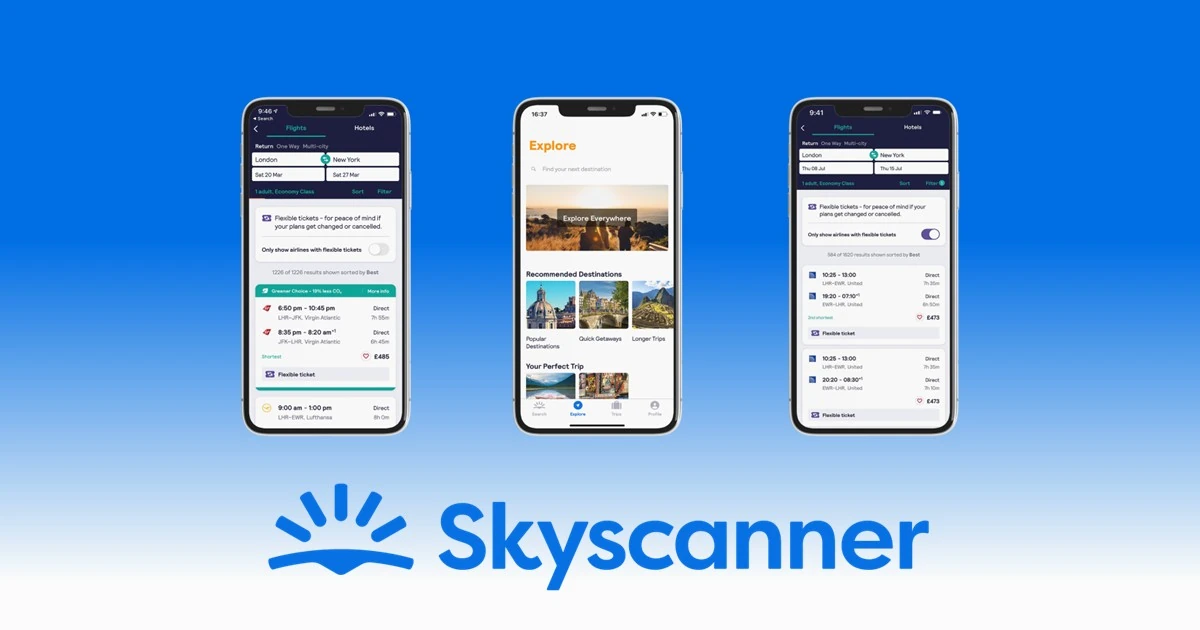
- Minimal, intuitive interface with smart filters (“cheapest,” “fastest,” “best”).
- Multi-city and flexible date search for advanced users.
- Transparent partner redirects, clearly labeling booking sites.
By being open about how results were shown, Skyscanner positioned itself as honest and unbiased, a trait that quickly became its competitive edge.
4. Powering Growth Through Partnerships
Skyscanner’s success relied on collaboration, not competition.
It integrated directly with airlines and OTAs via open APIs, ensuring data accuracy while building win-win relationships.
These integrations also allowed other travel startups to embed Skyscanner’s engine, expanding reach and reinforcing its leadership in the travel meta search category.
Skyscanner’s solution turned the chaos of online booking into clarity by uniting data, technology, and design under one mission: help users find the best deals with complete transparency.
“Skyscanner didn’t sell flights, it sold confidence.”
By redefining search as trust + speed + simplicity, the brand set a new standard for travel meta search worldwide.
Implementation & Strategy — Building and Scaling the Skyscanner Ecosystem
Executing a Vision of Seamless Search
Turning the idea of a travel meta search engine into a global platform required more than just clever coding.
Skyscanner’s implementation focused on three parallel tracks, technical innovation, strategic marketing, and global scalability.
Each decision reinforced its core promise: help travelers find better deals faster, without bias.
1. Technical Implementation: Speed, Scale, and Stability
Skyscanner’s engineering team built a cloud-native architecture designed to handle millions of real-time searches daily.
By breaking the platform into modular microservices, they ensured fast data retrieval and fault tolerance across regions.
Key Technical Moves
- API Integration Framework: Unified data feeds from airlines, OTAs, and car rentals.
- Microservices Infrastructure: Improved speed, uptime, and parallel processing.
- Smart Caching System: Stored frequently searched routes for instant load times.
- Machine Learning Models: Continuously improved search accuracy and ranking.
| Metric | Before Optimization | After Implementation |
|---|---|---|
| Average Load Time | 15 sec | < 2 sec |
| Data Sources Connected | 250 | 1,200+ |
| API Uptime | 92% | 99.97% |
2. Marketing Strategy: From Search Tool to Travel Brand
While the backend focused on performance, Skyscanner’s marketing team built trust through transparency.
They positioned the platform not as another booking site but as a neutral search companion that helps users make confident decisions.
Strategic Focus Areas
- SEO & Content Marketing: Ranking for high-intent keywords like “meta search engine,” “cheap flights,” and “travel deals.”
- App Experience: Mobile-first design with push-based price alerts and flight tracking.
- Localization: Multi-language support and regional campaigns to reach diverse markets.
- Brand Storytelling: Promoting Skyscanner as the traveler’s trusted search ally, not just a deals aggregator.
This strategy helped Skyscanner capture both search traffic and brand loyalty, essential in a competitive, price-sensitive industry.
3. Partnership & Growth Strategy
Skyscanner adopted a collaborative growth model rather than competing head-to-head with airlines and OTAs.
By offering fair visibility and quality leads, it became a preferred partner for many travel brands.
Partnership Tactics
- Direct Airline APIs: Ensured real-time fare accuracy and better commissions.
- Affiliate Integrations: Revenue-sharing with OTAs and local agents.
- Open API Platform: Allowed third-party developers to embed Skyscanner search within their apps.
These partnerships not only strengthened Skyscanner’s data network but also created an ecosystem effect, the more partners joined, the better the results became for users.
4. Global Rollout & Market Expansion
To achieve true global reach, Skyscanner localized its platform for over 30 languages and 70 currencies.
It invested heavily in regional UX testing, understanding that travelers in Asia, Europe, and North America searched differently.
The platform’s adaptability allowed it to expand into 180+ countries, often ranking in the top three travel sites by search volume.
Skyscanner’s implementation wasn’t just about building technology, it was about aligning engineering, marketing, and partnerships toward one vision:
A faster, fairer, and more transparent way to find travel deals worldwide.
Through this disciplined execution, Skyscanner turned a complex challenge into a global standard for meta search excellence.
Results & Impact — Redefining Travel Search Globally
Impact at a Glance
| Metric | Before Meta Search Expansion | After Implementation |
|---|---|---|
| Monthly Active Users | ~15 million | 100+ million |
| Global Markets Served | 5 countries | 180+ countries |
| Average Search Speed | 15 seconds | Under 2 seconds |
| Booking Conversion Rate | 2.3% | 5.8% |
| API Uptime | 92% | 99.97% |
| Mobile App Downloads | 10 million | 70+ million |
Skyscanner Financial Summary (2017–2024)
Skyscanner’s top line shows steady pre-pandemic growth, a sharp 2020 contraction, and a strong multi-year rebound, while gross profit accelerates faster than revenue from 2022 onward. The widening gap between the two lines in 2023–2024 suggests a healthier mix and improved unit economics, evidence that the business not only recovered volume but also rebuilt efficiency in how it converts traffic and partner demand into profitable margin.
Delivering Measurable Change
The success of Skyscanner’s meta search engine wasn’t just technological, it was transformational.
By focusing on speed, transparency, and user empowerment, the platform achieved massive global adoption and set a new industry standard for travel comparison.
Within a few years of refining its meta search model, Skyscanner saw exponential growth in traffic, engagement, and user satisfaction, proving that travelers valued clarity over complexity.
Business Growth and Market Leadership
Skyscanner’s consistent innovation turned it from a European startup into a top global travel search brand.
Its transparent business model and strong SEO performance helped it outperform traditional OTAs in organic reach and user engagement.
Key achievements include:
- Expansion into Asia-Pacific, North America, and the Middle East.
- Increased brand recall due to its trust-first positioning.
- High organic search dominance for keywords like “cheap flights”, “travel deals”, and “flight comparison”.
User Experience & Trust Metrics
User research and post-search analytics revealed clear improvements in satisfaction and trust:
- 90%+ user satisfaction rate across core features (flights, hotels, car rentals).
- Higher repeat usage, especially among mobile app users receiving price alerts.
- Reduced bounce rates due to faster loading and simpler navigation.
Together, these indicators validated Skyscanner’s core mission to make travel search simple, fast, and fair.
Traveler Behavior & Purchase Trends
When presented as a bar chart, the pattern becomes unmistakable: insurance and seat selection top the list at 36% each, followed by better food (29%), extra baggage (26%), and lounge access (22%). This ranking reveals that travelers aren’t just chasing cheap fares, they’re willing to spend more for comfort, control, and reassurance. For Skyscanner, these insights validate the value of highlighting ancillary options within search results and strengthening airline partnerships around personalized add-ons.
Industry Recognition
Skyscanner’s approach to meta search technology and user-centric innovation earned multiple accolades, including:
- “Best Meta Search Engine” – Travolution Awards
- “Top Travel App” – Google Play & Apple App Store Rankings
- Featured in Phocuswright’s Travel Innovation Report for driving industry-wide adoption of transparent meta search models.
Skyscanner’s impact extended far beyond numbers.
By rethinking how travel information is sourced, ranked, and presented, it changed how millions of people plan their journeys and how the travel industry defines trust in digital search.
Competitive Landscape — Standing Out in a Crowded Travel Search Market
A Market Defined by Choice and Competition
The travel search ecosystem is one of the most competitive digital industries where speed, trust, and user experience define success.
Skyscanner entered a market dominated by giants like Google Flights, Kayak, and Expedia, all vying for user attention through different models.
What set Skyscanner apart was its laser focus on neutrality and transparency.
Where others blurred the line between search and selling, Skyscanner’s commitment to unbiased aggregation gave it a distinct advantage with users who valued honesty over heavy marketing.
Competitive Overview
| Competitor | Core Strength | Limitation | Skyscanner’s Advantage |
|---|---|---|---|
| Google Flights | Powerful data access and instant results | Limited focus on hotels and multi-provider deals | Broader aggregation and stronger cross-category coverage |
| Kayak | Strong brand and intuitive interface | Owned by a booking group (bias perception) | Independent, neutral platform |
| Expedia / Booking.com | Full-service OTAs with direct sales | Prioritize own inventory | Transparent search without direct selling |
| Momondo / Trip.com | Regional niche presence | Limited international integration | Global consistency and multi-language reach |
Unlike its competitors, Skyscanner positioned itself as a pure meta search platform not a booking intermediary, earning it credibility as a “fair comparison engine.”
What Made Skyscanner Different
Skyscanner’s long-term competitive edge came from its balance of scale and simplicity.
While others invested in marketing dominance, Skyscanner invested in technology and UX refinement.
Key Differentiators:
- Neutrality: Independent from OTAs, ensuring unbiased results.
- Speed: Sub-2-second global search response times.
- Localization: Available in 30+ languages and 70+ currencies.
- Transparency: Clearly labeled redirects and no hidden markups.
- Multi-Segment Search: Flights, hotels, and car rentals in one unified experience.
This formula earned Skyscanner both trust and traction particularly among value-conscious and mobile-first travelers.
Strategic Positioning: The “Trusted Connector” Model
Rather than trying to dominate transactions like OTAs or replicate Google’s data-driven ecosystem, Skyscanner carved its niche as a trusted connector between travelers and providers.
Its strategy emphasized:
- Discovery over booking: Help users make informed choices, not force conversions.
- Technology as differentiation: Machine learning and APIs as key enablers.
- Community-based credibility: Relying on user reviews and social proof.
This allowed Skyscanner to maintain authenticity in an industry often criticized for opaque pricing and biased recommendations.
In a space filled with aggressive players, Skyscanner thrived by doing the opposite, focusing on trust, transparency, and simplicity.
Its independence and technical depth positioned it as a benchmark for ethical travel search, redefining how comparison engines should serve users.
While others sold bookings, Skyscanner sold belief, belief that travelers deserve the truth about prices.
Key Learnings & Takeaways — What Skyscanner Taught the Industry
From Aggregation to Trust: The Core Lesson
Skyscanner’s journey proved that success in travel tech isn’t just about data, it’s about how you earn user trust through that data.
By combining transparency, speed, and simplicity, Skyscanner turned the meta search engine from a niche concept into a mainstream behavior for global travelers.
1. Transparency Builds Loyalty
Skyscanner showed that being neutral and clear about pricing can outperform aggressive sales tactics.
Instead of pushing specific partners, the platform prioritized authenticity and users rewarded it with loyalty.
Key Takeaways:
- Trust drives long-term traffic better than discount-driven marketing.
- Transparency should be a feature, not an afterthought.
- Neutral algorithms build credibility faster than branded promotions.
2. Data Integration Is a Competitive Advantage
Behind Skyscanner’s simple interface lies a deep, technical achievement connecting thousands of APIs and data sources in real time.
This capability became its biggest differentiator and a major barrier to entry for competitors.
Key Takeaways:
- Real-time integration across sources enhances accuracy and user satisfaction.
- Scalability and reliability are critical for global digital platforms.
- Technical excellence translates directly into brand trust.
3. User Experience Defines Perception
No matter how advanced the backend, UX is what users remember.
Skyscanner simplified complex searches into clean, fast, and mobile-friendly flows, turning utility into delight.
Key Takeaways:
- Minimalist design helps users make quicker, more confident choices.
- Mobile-first strategies are now mandatory, not optional.
- Visual pricing tools (like graphs and alerts) increase user engagement.
4. Partnership, Not Competition, Scales Faster
Rather than battling airlines or OTAs, Skyscanner partnered with them.
This collaborative model allowed it to grow faster and improve data quality while keeping acquisition costs low.
Key Takeaways:
- Strategic partnerships amplify network effects.
- Shared-value ecosystems grow faster than isolated platforms.
- Collaboration leads to richer data and more trustable experiences.
5. Purpose Drives Innovation
At every stage, Skyscanner’s mission stayed simple to make travel search fair and effortless.
That purpose kept its teams aligned across technology, marketing, and product design.
Key Takeaways:
- Clear mission statements simplify decision-making.
- Innovation grows naturally when purpose and user value align.
- A brand rooted in trust can thrive even in highly competitive markets.
Skyscanner’s rise wasn’t just about outperforming competitors, it was about redefining what “good” means in digital travel.
By building technology around user trust, not just revenue, it created a model that future travel platforms continue to emulate.